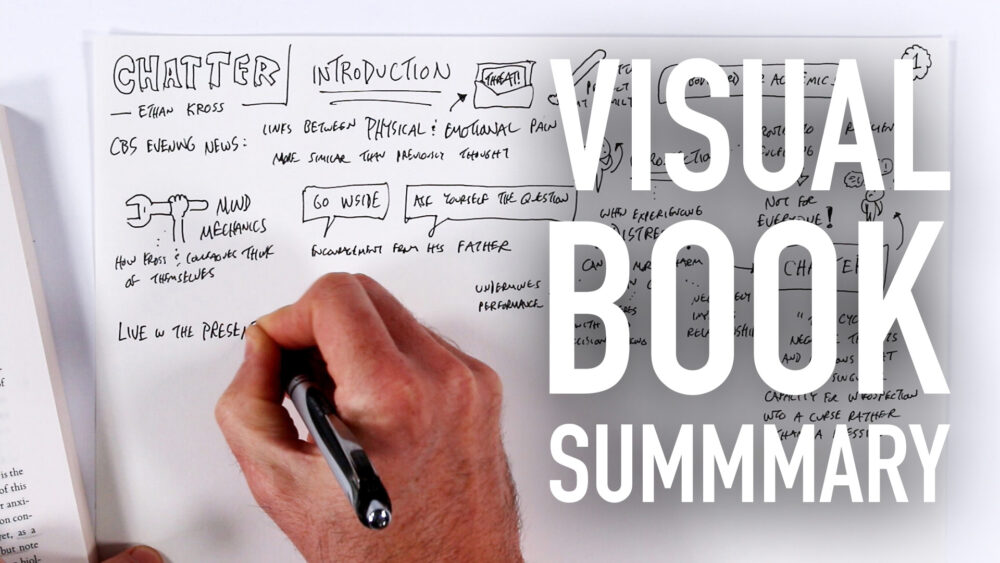
In this post, I want to bring you along with me as I get started on a new visual book summary. I’m currently reading Chatter by Ethan Kross, which is all about the voice in our head, why it matters, and how to harness it.
From the One Big Notebook to a Folder
If you saw my recent daily driver video, where I take you on a tour of the one big notebook that I use for everything, you’ll have seen that the notes on the last book I sketched out, Slow Productivity by Cal Newport, all lived in that single notebook, interspersed with lots of other visual notes, daily planning, and different forms of drafting.
While there are some real benefits to having literally everything in one notebook, I’m realizing there are a couple of situations, a couple of types of projects, where it’s probably worth moving away from it.
One example is what I shared in my last video: some one-and-done sketchnotes of a podcast conversation in a small Moleskine notebook, returning to one of my original formats from when I first got into sketchnoting over a decade ago.
And in the case of sketching out a book, it’s just too helpful to have one folder where all of your initial chapter sketchnotes can live. That’s what I’m starting here.
The Goal of this Stage
I’ve read and underlined the first few chapters of the book. The goal now, at this stage of note-taking, is to capture some initial rough visual notes of each chapter. By the end, I’ll have a good sense of the book as a whole, along with lots of individual ideas and some initial visuals to pull from for the creation of a single-page book summary.
That one-pager is my goal in this case, not a vertically oriented, short-form explainer video like I did with Slow Productivity, but a return to the larger-frame, horizontal-style, longer-format video like you’ve seen in my videos about Supercommunicators, The Infinite Game, or Sustainable Ambition, along with others that came before those.
So what I want to show you here is what this stage of note-taking looks like: revisiting the introduction and then the first couple of chapters, looking back at what I had underlined, and capturing the key stories, key definitions, and key frameworks that will help me remember and then apply the ideas from this book.
The Introduction
In the introduction, Kross talks about the chatter that kept him up at night holding a baseball bat, after receiving a threatening letter in the mail, a response to an article he’d written about the links between physical and emotional pain. He went so far as to do a Google search for “bodyguards for academics.”
He shares how he and his colleagues think of themselves as mind mechanics, as well as the role his father played in encouraging him to go inside on a regular basis, to ask yourself the question you’re considering. That led to his habit and skill of introspection, which he assumed to be a route toward a resilient, fulfilling life.
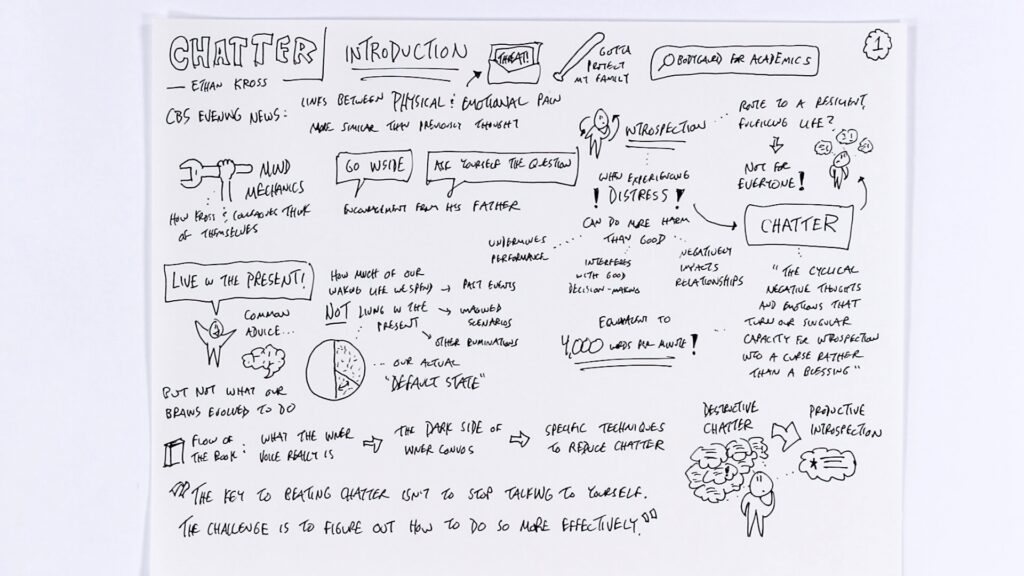
That turns out not to be the case for everyone, though, especially when experiencing distress. There are situations where introspection can do more harm than good: it can undermine performance, interfere with good decision-making, and negatively impact your relationships. That’s because of what he defines as chatter: the cyclical, negative thoughts and emotions that turn our singular capacity for introspection into a curse rather than a blessing.
A Few Techniques
One of the techniques you’ll see me using here is dots to connect one part of the page to somewhere else on the page. I find myself reaching for that especially when there are three or four examples related to a given concept, like those three examples of how introspection can do more harm than good.
As you can probably tell, I don’t have any predetermined layout in mind. I’m filling the page one chunk at a time, based on where white space is available, and attempting to connect ideas through proximity whenever possible. Generally, even with these rough notes, my goal is to come up with at least one visual hook for each idea.
Take the common advice of living in the present. That’s actually not what our brains evolved to do, we spend one-third to one-half of our time not living in the present, instead reflecting on the past or imagining potential futures, to the point where not living in the present is actually called our default state. And it’s kind of crazy that the chatter we experience can be equivalent to 4,000 words per minute.
Sometimes, when there’s an interesting fact or keyword, just adding a couple of underlines helps to emphasize it.
At the end of the introduction, Kross lays out the flow of the book: starting with a discussion of what the inner voice really is, then sharing the dark side of our inner conversations, and finally offering a set of specific techniques to reduce chatter.
I had enough space left on the page to add a summary quote here:
The key to beating chatter isn’t to stop talking to yourself. The challenge is to figure out how to do so more effectively.
Then I tried to reflect on: okay, what is this introduction about, and therefore what is this book as a whole about? It’s this transition from experiencing destructive chatter to productive introspection, from that jumble of thoughts and emotions to something that gives us more clarity.
Chapter 1: Why We Talk to Ourselves
Then it’s on to chapter one, “Why We Talk to Ourselves,” which starts out with a story about a study done in New York City, where Kross sought out volunteers to capture their inner monologues over the course of a few hours in their day.
This is an example where there’s one story being told and then a lot of takeaways from that story. So starting with a simple sketched scene was a good way to go, then capturing some of the takeaways around it, like the discovery of how we hopscotch through time and space during those inner monologues, through this form of mental time travel. (I connected that to one of the principles from Thinking in Bets, where Annie Duke also talks about mental time travel.) We also learn how that inner monologue can sometimes be constructive and sometimes not, and how often it is self-focused.
Then we get to a discussion of our working memory and its role in managing verbal information, specifically the phonological loop, which, given the name, lends itself to a simple diagram: a back-and-forth between the inner ear and the inner voice. The inner ear helps us retain what we just heard for a few seconds; the inner voice is where you repeat words in your head to remember them until they’re needed.
You can see here how I’m settling into what I sometimes call the “brick road” approach to visual note-taking, filling the page one rectangle at a time, for each idea or set of ideas, with a balance of imagery and text within each chunk.
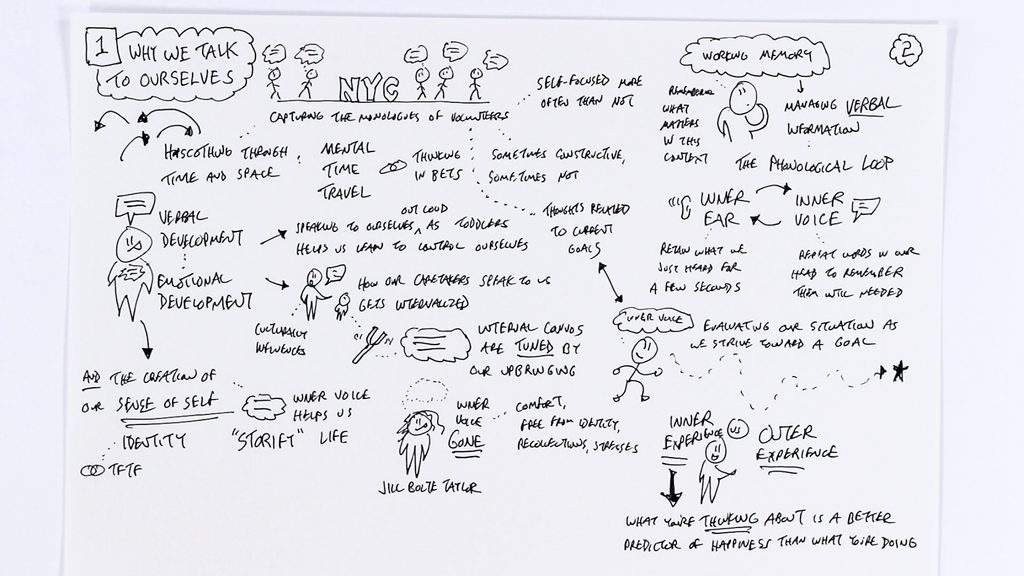
Kross then talks about the link between verbal development and emotional development: how speaking to ourselves out loud as toddlers helps us learn to control ourselves, and the important role of how our caregivers speak to us, because that gets internalized. The nature of that speech from our caretakers is what tunes our own internal conversations, and that voice from our caretakers is, of course, influenced by the culture they grew up in as well as their individual personality.
That phrasing of “tuning” our internal conversations resonated with me (pun not intended), so the imagery of a tuning fork came to mind.
We also hear how our inner voice helps us evaluate our current situation as we strive toward a particular goal. It plays a role in the creation of the sense of self and establishing your identity, which made me think of the concept of identity triggers from Thanks for the Feedback, another book I’ve sketched out.
We hear the example of Jill Bolte Taylor, whose inner voice went away because of a stroke, and the comfort that came from that experience, the freedom from having to manage your identity, all of your recollections, and all of your current and imagined stresses. Note how I used a dotted line for that thought bubble, to show that the inner voice was gone.
We also learn that your inner experience is often much more impactful than your outer experience, how what you’re thinking about is a better predictor of happiness than what you’re actually doing.
That’s it for chapter one. There’s a little bit of white space left on this page, but instead of trying to cram the start of chapter two here, it makes more sense to give it a fresh page.
Chapter 2: When Talking to Ourselves Backfires
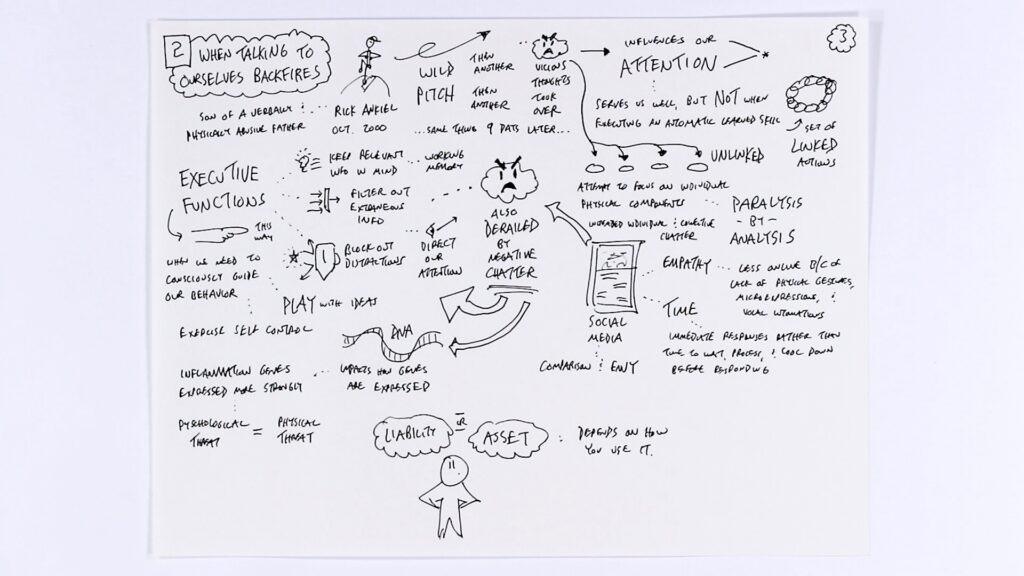
This is a chapter on when talking to ourselves backfires. Here we get the story of pitcher Rick Ankiel. I’d already drawn a pitcher on the mound for my visual summary of the book Make It Stick, which made this one a lot easier and quicker to draw.
We hear the story of how one wild pitch led to another, and then another, because vicious thoughts took over. Here we get to some personification that I ended up reusing across this page: putting a face on a thought bubble to make it this angry character, and connecting that to the idea that our inner monologue, especially when it gets negative, influences our attention.
Is that attention focused on a single point? That’s sometimes helpful, but not when you’re attempting to execute an automatic, learned skill, like the set of linked actions required to throw a pitch. Ankiel spent years of his career linking those actions, but after that wild pitch, vicious thoughts took over. That can cause your mind to focus on each individual physical component of what you’re doing, which un-links them. You get paralysis by analysis, which ruins your performance.
Executive Functions
All of this on the page so far is kind of one flow of connected ideas. But then we get to a new topic, so I move over to a chunk of white space and start with just the title of this new topic: executive functions.
These are a set of skills for when we need to consciously guide our behavior, instead of just relying on our instincts and intuition. There’s a whole set of skills related to executive function, so you’re going to see those dots again. It’s about keeping relevant info in mind (that’s your working memory), filtering out extraneous info, blocking out distractions, playing with ideas, exercising self-control, and directing your attention.
That’s a clump of things related to this one topic of executive function. Then I redraw our vicious thoughts and share how all of those tasks are also derailed by negative chatter.
Social Media
We then switch to the topic of social media. So I find the next bit of white space, draw a phone, then a very abstract image of a comment section below it, and connect it to two ideas: how social media relates to empathy and to time.
There’s less empathy online because of the lack of physical presence between two or more people. And the immediacy of response inflames the discourse, rather than giving us some time to wait, process, and cool down before responding, the kind of time that’s often built into our day-to-day life outside of screens. That’s why social media can lead to increased individual and collective chatter.
When Thoughts Reach the Body
Those vicious thoughts also impact our DNA, they affect how genes get expressed, which can lead to more inflammation. In your mind, there’s not a difference between a psychological threat and a physical one.
This chapter ends with a question: are those thoughts, that inner monologue of yours, a liability or an asset? Well, it depends on how you use it. And the rest of the book is going to show us how to use it well.
Again, here I end up with some white space left on the page. As before, I’m not going to start chapter three notes here, it’ll get its own page, in a future work session. So for now, I’m going to collect these pages together, put them in that envelope, and return to them soon.
The Value of Chapter Sketchnotes
I hope it was helpful to see the creation of these chapter-by-chapter sketchnotes, which have standalone value on their own, whether or not I go on to create a one-page book summary. They give a much better overview of these topics than just flipping through the book and scanning the underlined passages.
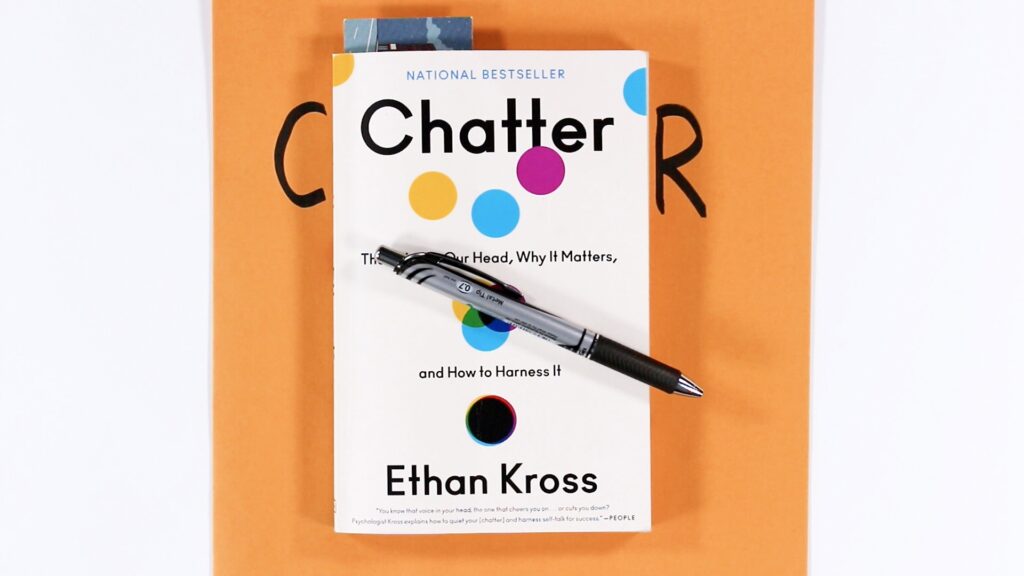
Because of the limitations of our working memory, as Kross talks about, and as we frequently talk about here as it relates to the benefits of visual note-taking, those underlines you read to yourself are going to float away pretty quickly. The sketched images and diagrams on the page? Not so much. They stick around, and they’re easier to reference.
Want to Start Your Own Visual Notes?
If this post has you excited about taking your own visual notes but you’re not quite sure where to start, check out our library of courses, which will get you up and running with these skills so that you can apply them in your personal and professional life.

Thanks for following along at the start of this new project. Let me know if you’d like to see the rest of my chapter sketchnotes from this book, or if you’d rather pick things up at the next stage of the process, where I’ll go from a set of chapter sketchnotes to the drafting of a one-page visual summary. Let me know in the comments.
Good luck with your own visual thinking projects, and I’ll see you next time.
Cheers,
-Doug