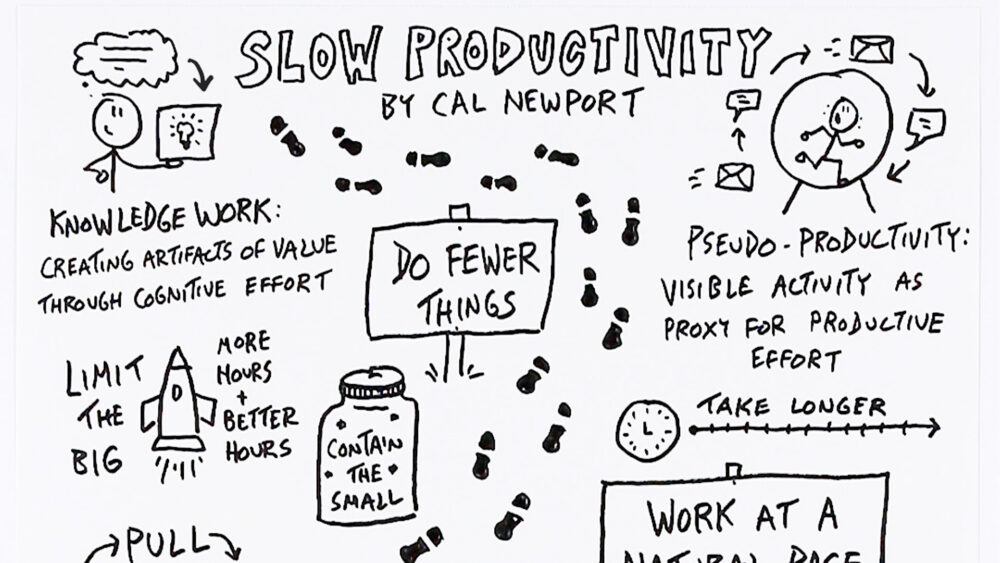
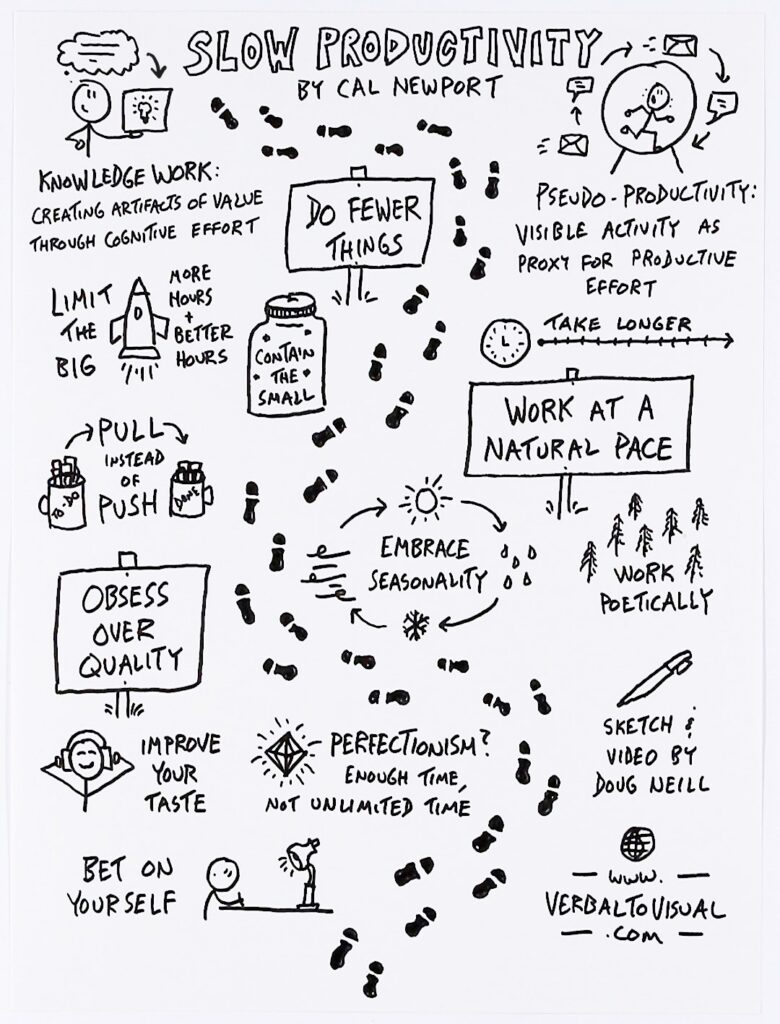
In his book Slow Productivity, Cal Newport shares with us the lost art of accomplishment without burnout. Here I’d like to sketch out some of the highlights.
Knowledge Work and Its Trap
First, it’s worth noting that Newport is talking specifically about knowledge work, which he defines as “the economic activity in which knowledge is transformed into an artifact with market value through the application of cognitive effort.” In other words, it’s about using your brain to make something that’s useful for others.
Before we get to what slow productivity is all about, let’s first acknowledge its opposite: pseudo-productivity, “the use of visible activity as the primary means of approximating actual productive effort.” It’s responding to emails quickly, keeping up on your Slack messages, and checking off all of those minor to-dos that don’t actually lead to the creation of something valuable.
So what’s the slow approach to productivity? It has three components.
1. Do Fewer Things
One suggestion here is to limit the big. Limit your overall mission, limit the number of projects you take on, and even limit your daily goals. That way you can spend more hours on a smaller number of projects, and because of the benefits of focus, those become better hours.
On the other end of the spectrum, Newport encourages you to contain the small. Don’t let the small tasks, like answering email, take over your entire day. And consider implementing a pull system instead of a push system for tasks that land on your plate. Rather than facing an ever-growing list of things you need to be working on right now, focus on one thing at a time. Only when you’re done with that do you go back to the to-do list and pull in the next thing to work on.
2. Work at a Natural Pace
One proposition here is to take longer. Consider that it took Lin-Manuel Miranda eight years between the first draft and the Broadway debut of his first musical, In the Heights.
Newport also encourages us to embrace seasonality. Schedule slow seasons throughout the year, or cycle between big, energy-intensive work projects and rest projects that you can take on at a more leisurely pace.
And you might even work poetically. Follow the lead of poet Mary Oliver, who wandered the woods and jotted down notes as they came to her. Get out of your normal context to open up your mind to new possibilities.
3. Obsess Over Quality
The third and final principle is to obsess over quality. As Newport puts it: “Obsess over the quality of what you produce, even if this means missing opportunities in the short term. Leverage the value of these results to gain more and more freedom in your efforts over the long term.”
Newport encourages you to improve your taste, and not just within your own domain but in others as well. He became a cinephile, which exposed him to nonlinear narratives that he has at times woven into his nonfiction work. For you, it might be music or the visual arts.
And in addressing the potential for perfectionism to creep in with this slower approach, Newport’s advice is to give yourself enough time, but not unlimited time, on your creative projects. He says: “Obsession requires you to get lost in your head, convinced that you can do just a little bit better given some more time. Greatness requires the ability to subsequently pull yourself out of your self-critical reverie before it’s too late.”
He also encourages you to bet on yourself. That might mean writing after the kids go to bed, temporarily dedicating significant amounts of free time to the project in question. Or maybe you announce a schedule to get some social capital behind your work.
Freeing Yourself From the Grip
The goal of slow productivity is to free yourself from the dehumanizing grip of pseudo-productivity by restructuring how you approach knowledge work: by doing fewer things, working at a natural pace, and obsessing over quality.
For more suggestions, examples, and other details, do go pick up the book — and read it, slowly.
Want to learn how to take visual notes like the ones you see here? Check out these resources.