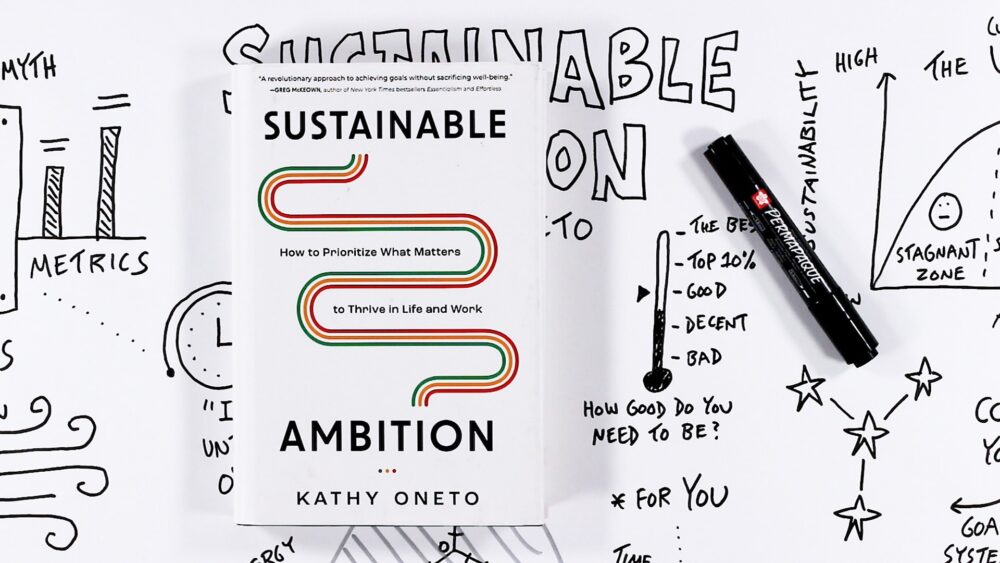
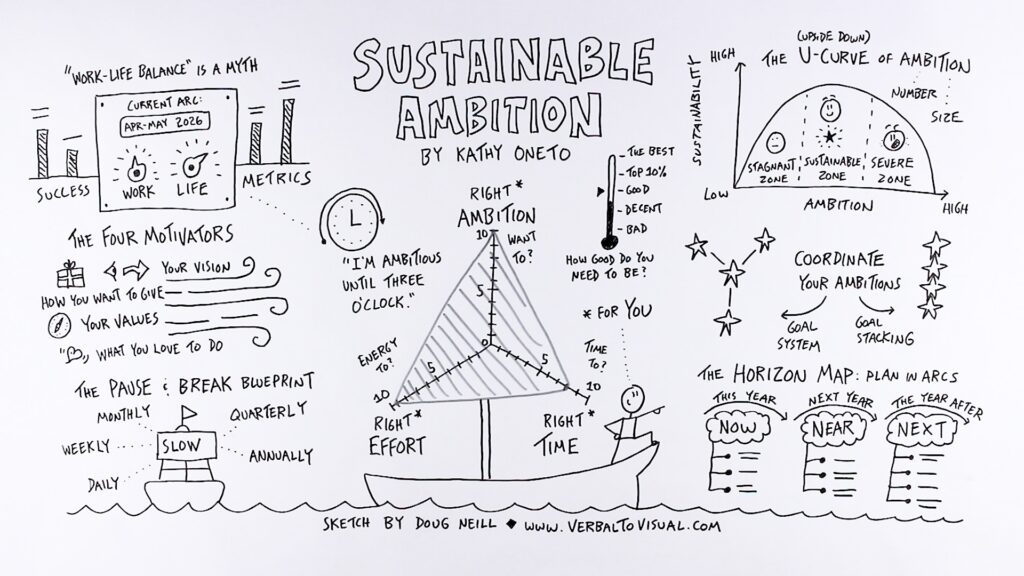
A visual book summary of Sustainable Ambition by Kathy Oneto.
Here’s a sentence I didn’t know I needed to hear: You can be a deeply ambitious person and be done working by mid-afternoon. Those two things are not in conflict. And this book explains why.
Let’s get into it.
Why This Book Caught My Attention
Hello and welcome to Verbal to Visual. I’m your host, Doug Neill, and my mission here is to bring visual thinking on par with reading and writing as a fundamental skill that can help you make sense of your world and thrive within it.
Today I’ll be applying that skill to Sustainable Ambition by Kathy Oneto as I sketch out some of my favorite ideas from it.
I felt myself being pulled toward this book from the moment I heard the title. I consider myself to be an ambitious person, but at times I’ve wondered if my ambitions have been, on the whole, helpful — or at times damaging. So the concept of sustainable ambition is one I can get on board with.
The Sustainability Sail
Let’s start with a visual metaphor that incorporates what, for me, was one of the most useful tools from the book.
Picture yourself out on a sailboat. The size of your sail represents three things working together:
- The right ambition — How much do I want to do this? (Rate it 0 to 10.)
- The right effort — How much energy do I have for this? (Rate it 0 to 10.)
- The right time — Do I have the time to do this right now? (Rate it 0 to 10.)
It’s important to note that “right” simply means right for you. There is no universal right or wrong here.
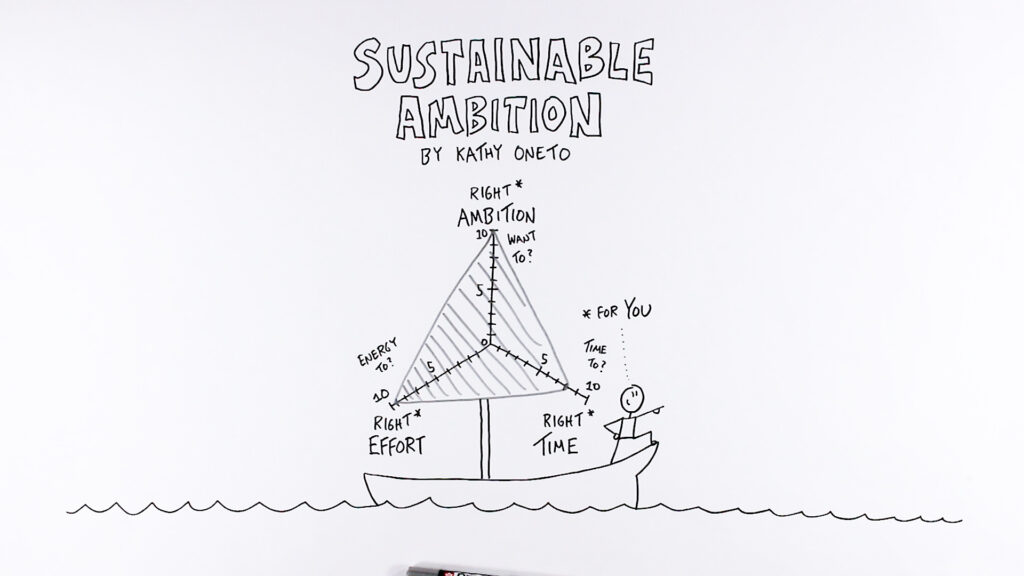
By the time you’re done reading the book — and maybe even by the time you’re done reading this post — you’ll be able to consider any ambition that’s on your plate, give each of these questions a score from 0 to 10, and then connect the dots to see how big your sustainability sail is. That will help you get a sense for whether that particular ambition is worth pursuing.
But in order to answer these questions well, it helps to learn the other principles introduced in the book. So let me share some of my favorites.
Work-Life Balance Is a Myth
Early in the book, Oneto makes the argument that the concept of work-life balance is a myth.
First of all, it creates the wrong mindset, establishing an unrealistic expectation that work and life need to be in balance at all times. And it puts work first, with the subtle implication that your work life deserves priority over your personal life.
What if you put life first? And what if you instead thought of work and life as two different dials, each of which you get to turn up and down independently, focusing on one arc at a time?
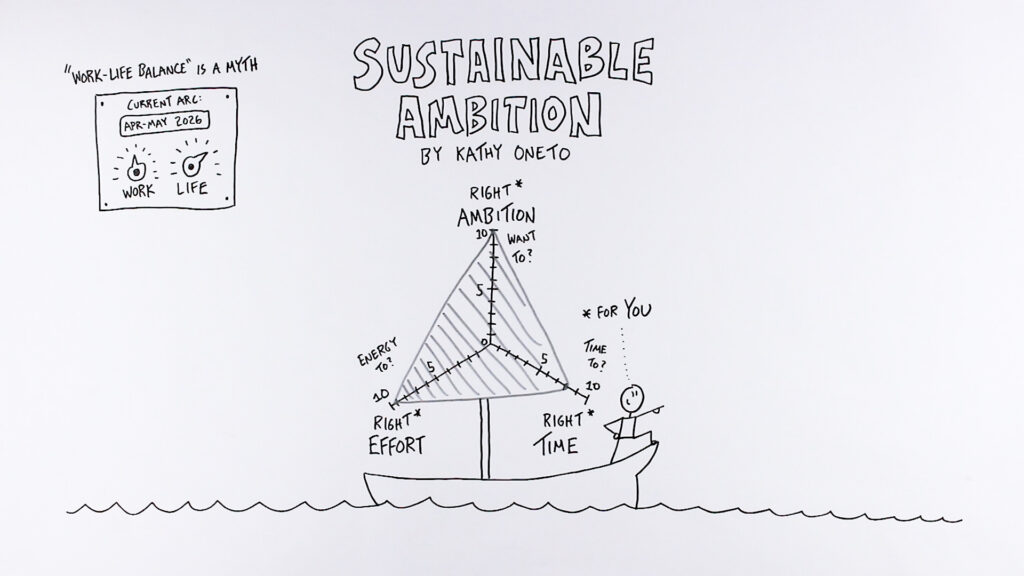
You might be in a period where your personal life is dialed up and your work life is dialed down — maybe as you’re supporting loved ones through a transition. Or maybe your work life is dialed up right now and your personal life is dialed back a bit as you pursue specific professional ambitions.
I like this dial metaphor because it provides so much more flexibility compared to the concept of striking a balance and staying there.
Define Your Own Success Metrics
Thinking about life and work as dials you can turn up or down also encourages us to define for ourselves our own success metrics, as opposed to defaulting to those given to us by society.
This is where we get to one of my favorite quotes from the book, which comes from a journalist and communications consultant who said:
“I like to say now that I’m ambitious until 3:00.”
There’s something refreshing about defining that as one of your success metrics.
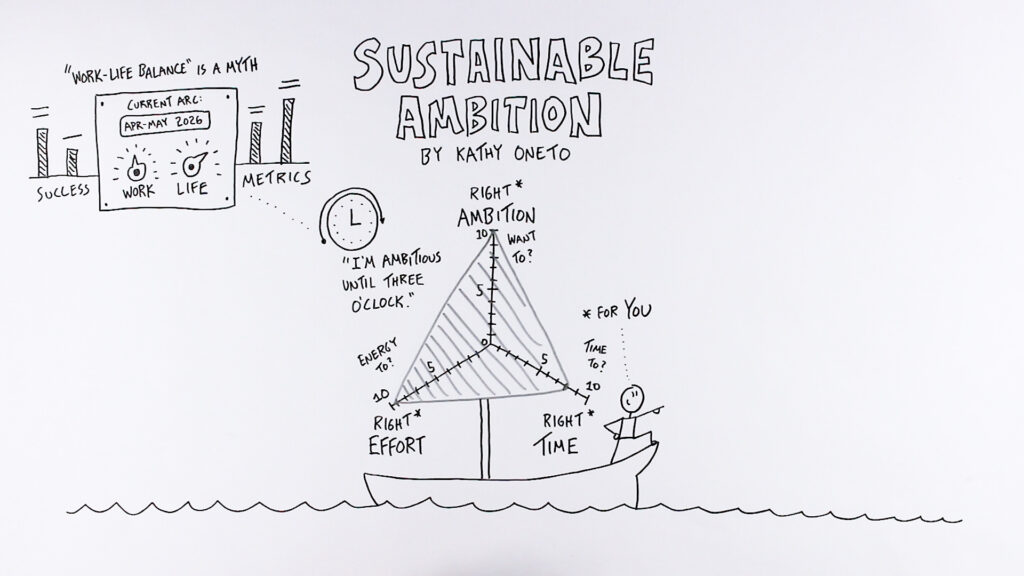
When I took the time to define my own success metrics, I landed on six P’s:
- Property — The number of days I stop working on Verbal to Visual after lunch and get outside to work on our property. We recently bought a home on two acres, and current projects include establishing a food forest and building a home office up in the forest.
- Parenting — The number of non-demanding (or “non-parenting”) interactions per week with my boys. Just meaningful time spent together.
- Partnering — The number of dates or date-like experiences with my wife per month.
- Playing — The number of social interactions I have per month.
- Publishing — The number of times I hit publish on a YouTube video or go live on a workshop I’m hosting.
- Presencing — the percentage of time each day that I feel tuned in to what’s going on inside my own body.
Those are some of my success metrics. You, of course, get to set your own.
Avoiding the Overcommit Trap
One thing to be on the lookout for is overcommitting. This is where the next framework comes in: The U Curve of Ambition.
Plot sustainability against ambition, each from low to high, and you get an upside-down U curve:
- If your ambitions are too low, you might be stuck in a stagnant zone, which doesn’t feel good and isn’t a sustainable place to be.
- If your ambitions are too high, you might enter the severe zone, where there’s too much on your plate to handle.
- What we’re searching for is the middle ground — the sustainable zone.
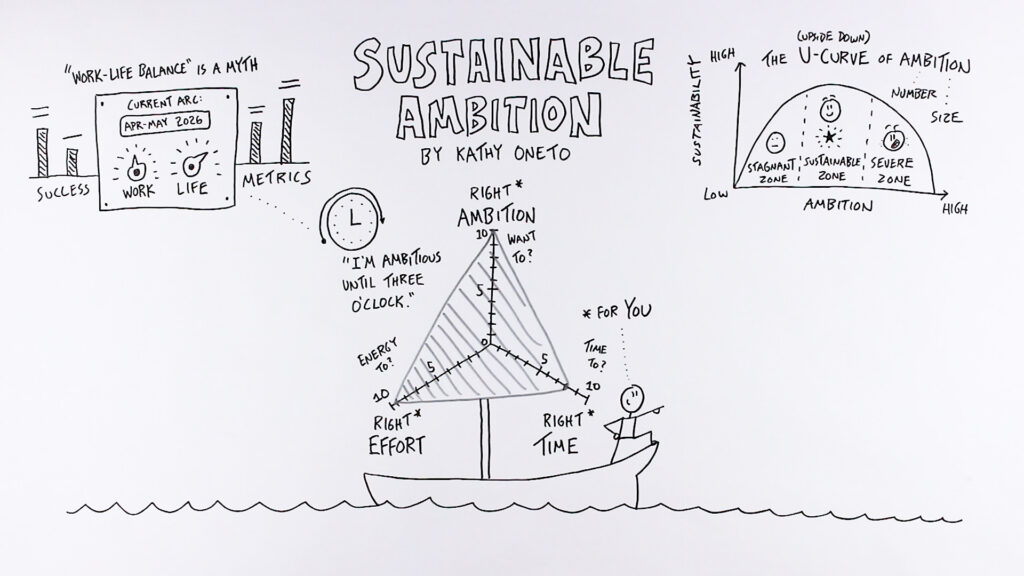
In the sustainable zone, you’ve identified both the right number of ambitions and the right size for each one. The number of ambitions you take on at once are few enough to stay in that zone, and the success metrics you set for each are right-sized to stay there too.
The Four Motivators
But how do you go about evaluating which of your potential ambitions are actually right for you? That’s where the next framework comes in.
These four motivators provide the wind that propels your sailboat forward:
- Vision — The vision you have for your life. Not a vision imposed by others, but your own.
- Give — How you’d like to use your specific gifts in your personal and professional life.
- Values — Pulling from value fulfillment theory, which states that to live well is to succeed in terms of your own values. That alone could be your single success metric.
- Love — What you love to do. This is where you pay attention to your intrinsic motivation instead of falling back on the shoulds that exist in so many facets of life.
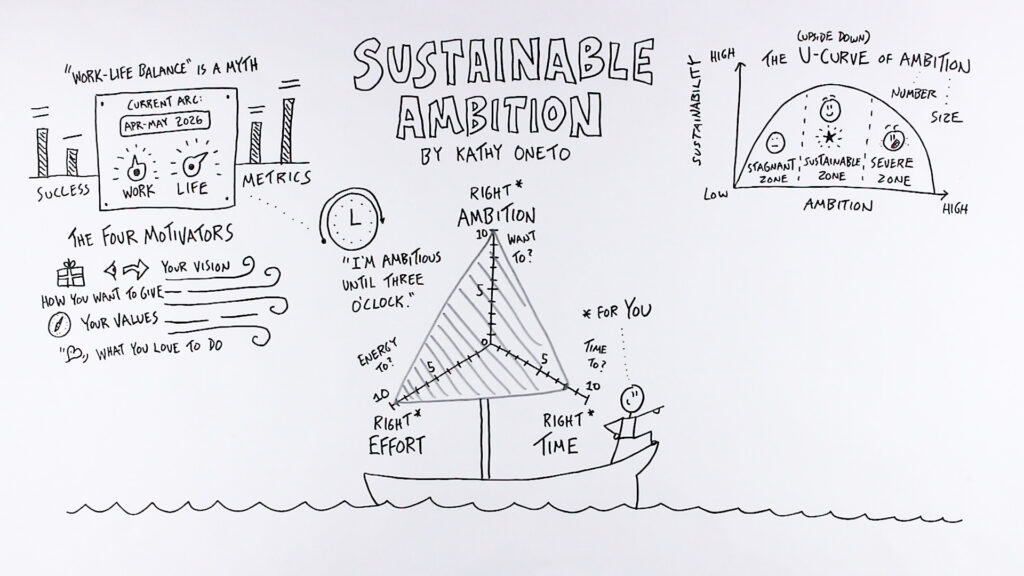
So when you’re considering a specific ambition, ask yourself: Is it in alignment with your vision for the life you’d like to lead, as well as the ways in which you’d like to give, and your values, and what you love to do?
If you find the right amount of alignment there, it’s likely that you’ll be able to bring the right amount of effort to that ambition.
The Pause and Break Blueprint
Remember, we’re talking about sustainability here, so it’s not about full effort all the time. You need to be intentional about taking breaks. That’s where the pause and break blueprint comes in.
This is where you set up buoys along your path to remind you to slow down, to pause, and to take a break at various time scales:
- What does a daily pause and break look like?
- How about a weekly pause and break?
- Or a monthly one?
- Or an even bigger quarterly or annual break?
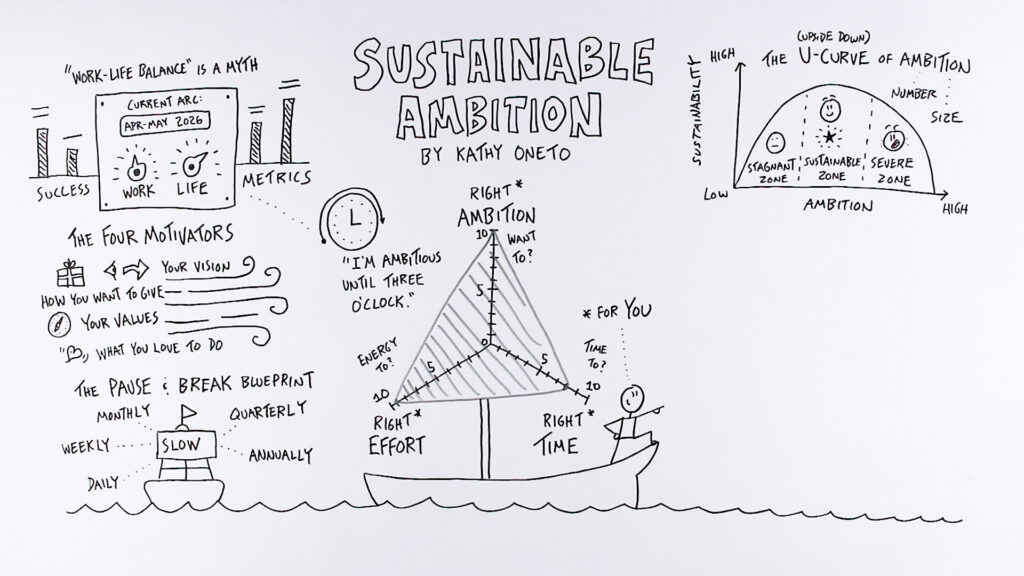
When reading this section, I reflected that I’m pretty good at taking breaks on a daily and weekly basis — small breaks throughout my day to sit and read a book or go for a walk, and the natural break that occurs on the weekend. But I’m not very good at setting up longer breaks on larger timescales.
It just so happens that yesterday was my twin boys’ fifth birthday, and it hasn’t been since they were born that I’ve taken any sort of extended break from my work. At that time I created for myself about a three-month sabbatical.
Now, because of reading this book, I’m setting the intention for my next sabbatical to be over the summer of 2027. I’d like to create the conditions where that’s possible. Since I run Verbal to Visual as a one-person business, it will take some planning — but it is possible. And I’m hoping that by declaring those plans now, I’ll be able to set the things in place to make that sabbatical a reality.
For my work, that boils down to two things: preparing some videos in advance that I’ll be able to publish across those three months, and hiring someone to host the weekly workshops that occur inside Verbal to Visual.
Which makes this a good time to mention that if you’re enjoying the way I’m sketching out these ideas from this good book, and you’d like to incorporate this skill into your own learning, problem-solving, and communication — that’s exactly what I teach here. You’ll find a full library of visual thinking courses and weekly live events where we dive deep on specific skills, where you can get feedback on your own visual thinking projects, and where you can be inspired by the work of other visual thinkers from around the globe. You can check it all out through a free week-long trial here.
Coordinating Multiple Ambitions
Let’s now round out our discussion of sustainable ambition with a few more key ideas.
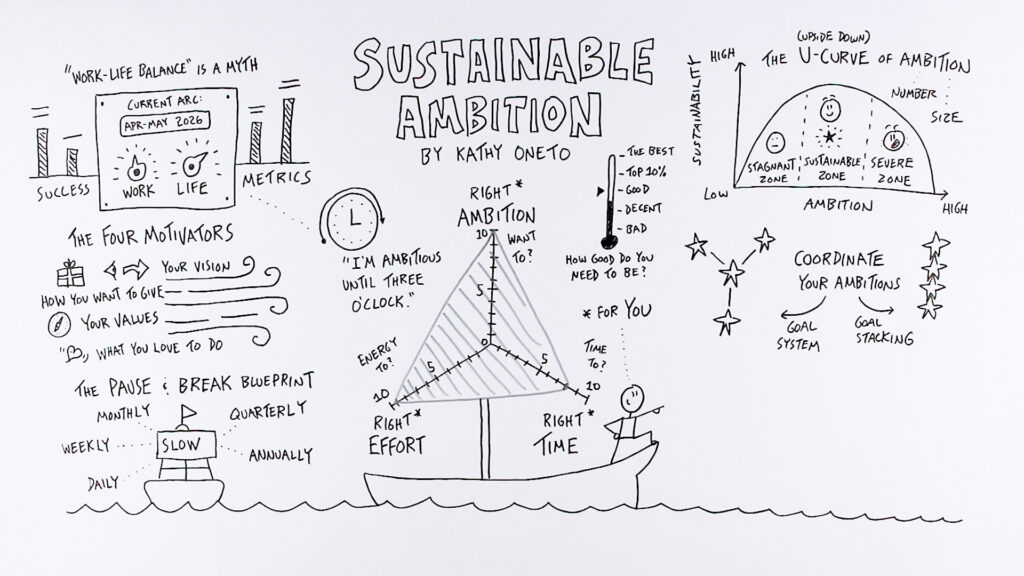
As you’re considering multiple ambitions across work and life — and this is something I maybe haven’t emphasized enough: your ambitions for your life are just as important as your professional ambitions — you might find it helpful to coordinate your ambitions in one of two ways:
- Goal stacking — Sequencing your ambitions one after another, if they build on each other in that way.
- Goal system — Focusing on a central ambition first that, once established, supports a handful of connected ambitions.
How Good Do You Need to Be?
As you consider each of those ambitions, it’s worth asking yourself: How good do you need to be?
Anyone who considers themselves an ambitious person has likely experienced perfectionism. You might think that for every ambition you take on, your goal should be to be the best. But that is not the case.
There are plenty of areas in your personal life and professional life where just getting to good will serve your purposes well. So it’s worth setting a specific target so that you can match the effort you give to the specific level of aspiration you have for that particular ambition.
The Horizon Map
To help you manage and coordinate your various ambitions, create for yourself a horizon map, which will allow you to plan in arcs and identify:
- Which ambitions are you focusing on now?
- What other ambitions might be in the near term?
- What others might be next?
You can set your own specific time frames for these buckets, and maybe add a fourth for some time later.
I like to think in chunks of years: what I’m doing this year, what I might take on next year, and what I might place the year after that. You might enjoy a shorter time frame like quarters, or longer time frames like two- or three-year chunks.
No matter the specific time frame, it’s helpful to place some of your ambitions in the future — give them a placeholder location — to make it easier to focus on the discrete number of ambitions you’re choosing to pursue right now.
Bringing It All Back to the Sail
To help you make that decision, let’s return to the sustainability sail.
When deciding which opportunities to pursue right now, you might find it helpful to sketch out this diagram for each of the potential ambitions you’d like to take on. Seeing them side by side gives you more clarity about what your life might look like overall during this next arc.
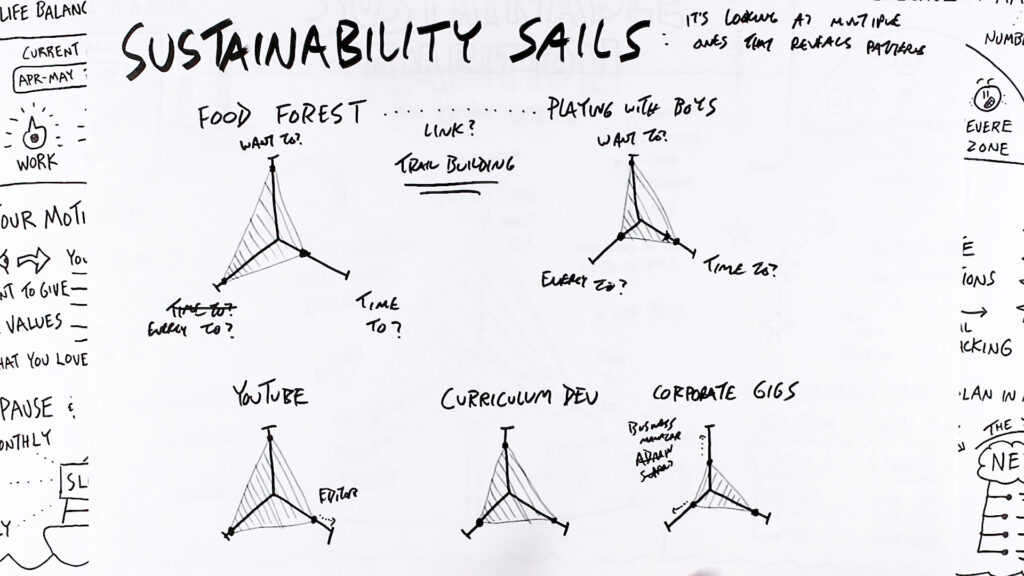
Here are a few examples I sketched out on a flip chart on the wall.
As I mentioned earlier, one of my ambitions is to establish a food forest on our property — something I very much want to do and have a whole lot of energy for, but don’t have a whole lot of time for.
Another ambition is to spend a lot of time playing with my boys while they’re still at this young age. That’s something I want to do and have a decent amount of time for, but oftentimes, especially after a day of work, I don’t have as much energy as I’d like to get into that playful mode.
But in sketching these life ambitions out side by side, I recognized a link: the boys do like spending time outside, and specifically building trails up in our forest — along which we’ll be planting food, and which will lead to the home office I’ll be building. So bringing these two together is a natural way to pursue both ambitions at once.
On the professional side of things, one of my ambitions is YouTube. Another is continuing to build out the curriculum that exists within Verbal to Visual. And another potential ambition I’ve had at times is to seek out corporate gigs — custom visual thinking workshops that I host for organizations.
This has the potential to bring in a decent amount of money, but after pursuing it for a while, I realized it really wasn’t something I wanted to do or had the energy to do, partially because of all the admin that has to go into even setting up one of those workshops. I have much more energy and excitement for making videos here on YouTube.
What’s also helpful to note is what it would take to extend any of these metrics in a positive direction:
- I would have more time for YouTube if I hired a video editor. Right now I edit all my own videos, but in the future I might pursue this.
- I might feel differently about corporate gigs if I hired a business manager to support the admin work. If I could spend less energy setting them up and instead get to just show up and work with an interesting group of people, that would make the ambition more in alignment with my life.
I also noticed that curriculum development is something I do want to pursue, but I sometimes have a little less desire and energy for it compared to making YouTube videos. That’s something I need to acknowledge so that I set aside the right amount of time to keep improving the curriculum. Right now that looks like the commitment I’ve made to add one new lesson per month to the Examples section of the Make Models course — the course I spent all of last year building.
Your Turn
I encourage you to sketch out your own sustainability sail for each of the personal and professional ambitions you’re considering, so that you can see them as a set, see how they interact with each other, and then make a decision about what you’d like to pursue and how.
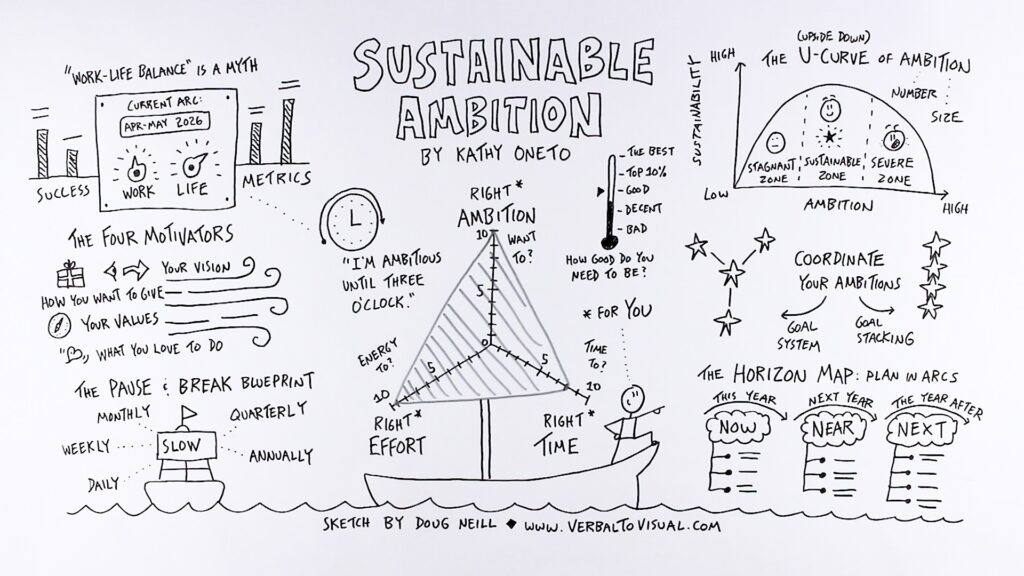
And if you’re in the midst of making those decisions, I highly encourage you to go pick up the book Sustainable Ambition. There are plenty of stories and frameworks that I didn’t have time to mention in this video, and I believe that while reading it, you’ll gain a whole lot of clarity around the next steps you might like to take in your personal life and your professional life — and then start taking those steps sustainably.
Thank you so much for exploring these topics with me. If you decide that building your visual thinking skills is an ambition you’d like to take on, do consider joining us inside Verbal to Visual. I’d love to see what you’re working on.