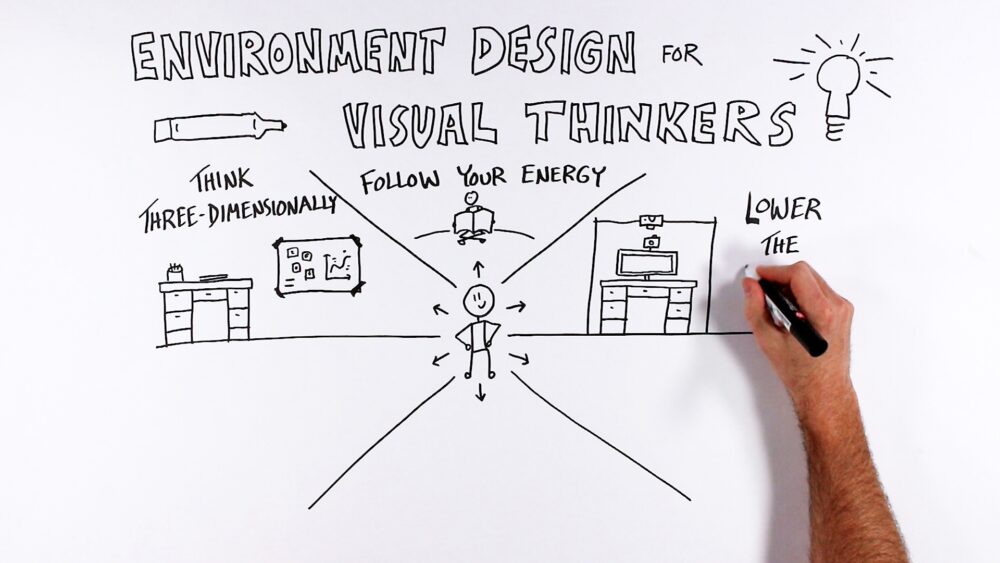
Later this year, I’m going to be building a new office from the ground up on our two-acre property just outside of Eugene, Oregon. That has got me thinking about the design of physical spaces — specifically, spaces for creative work.
I’ve had to set up many different office spaces of my own throughout the years, and in this post I’d like to share six principles for designing your own physical space, especially if you’re a visual thinker.
Visual thinking is all about sketching out drawings and diagrams to help you make sense of things. When thinking about this type of work, it’s easy to focus just on which notebook to use and which pen or marker to use. But the book The Extended Mind by Annie Murphy Paul got me thinking differently about the role of environment.
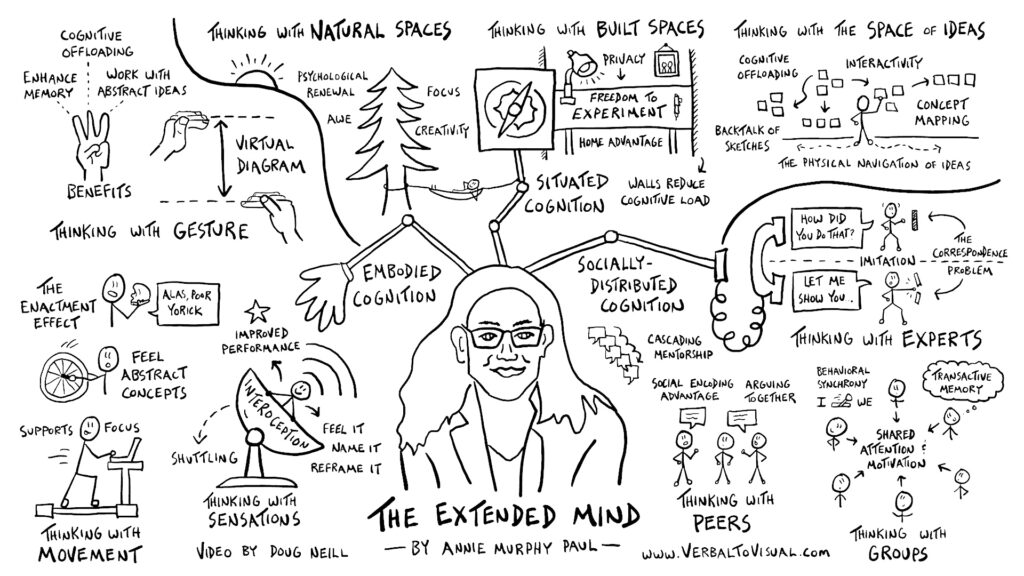
She talks about situated cognition: the benefits that come from thinking with natural spaces, thinking with built spaces, and thinking with the space of ideas. In this post, we’re going to focus in particular on the second of those: thinking with built spaces. How can you design your physical environment to extend your brain and support not just what you’re thinking about, but what you’re making — what you’re doing with those thoughts?
My goal here is to remind myself of these principles as I design my new office, and I also hope that what I share might give you some ideas for how to craft your environment in a way that supports the work that you care about. As I share these six principles, I want you to think about how you currently make use of your physical environment — and then, ideally, how you might improve it.
1. Think Three-Dimensionally
The first thing I encourage you to do is think beyond that two-dimensional surface of whatever it is you’re sketching on — that notebook, that piece of paper — and also think beyond the desk or table itself as you consider your surrounding environment.
As visual thinkers, we spend most of our time in the two-dimensional world, sketching things out on a sheet of paper. But when I was reading the book Visual Collaboration, I came across a term that I immediately fell in love with: the idea of creating for yourself (and perhaps for others) a learning arena, where you make use of more than just one surface.
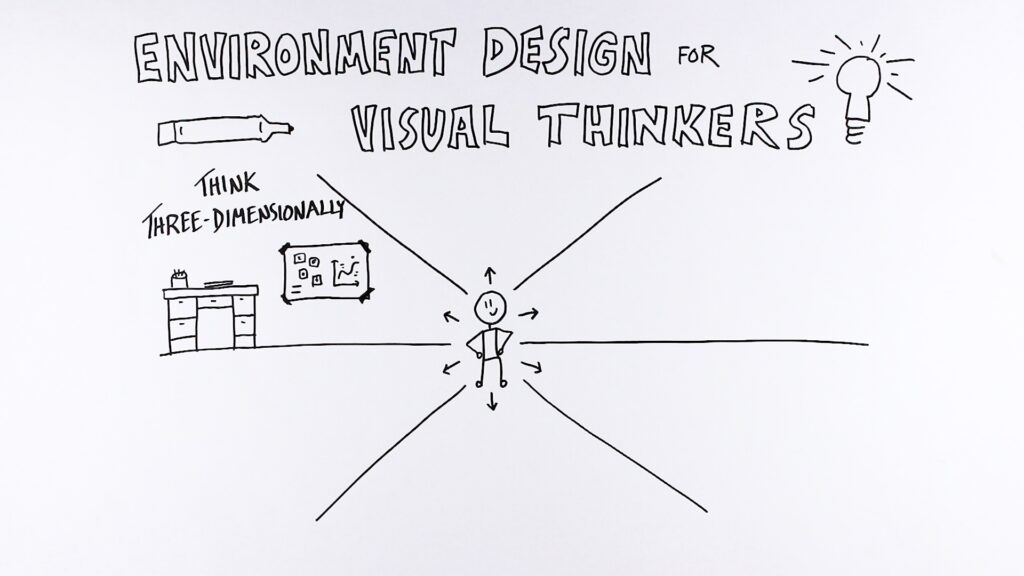
It’s not just about your desk and the notebook or tablet that’s on top of it. Instead, it’s about the walls — using poster paper or flip charts. You can also think about other surfaces beyond just your desk, like the floor. What if you spread your ideas out and could walk through them?
So this suggestion to think three-dimensionally is about looking for the opportunity to create different workstations inside of a single environment. And the reason that’s important is because it allows us to do the next thing.
2. Follow Your Energy
One of the workstations that I have set up in my space right now is on the floor. I’ve got a soft rug to sit on and a little floor desk, which is where I start my day reading and having some coffee. After that, I move over to my primary workspace to start tackling the most creatively demanding work of the day. After working there for a while, I start to feel it in my body that it’s tired of sitting down, so I get up and work on a flip chart on the wall.
As we learned in the book The Power of Full Engagement, humans aren’t built for steady energy expenditure across the entire day. Instead, we need a more cyclical approach of energy expenditure and energy recovery. That could look like taking a break from your work to go sit on the floor and read for a few minutes. But it also looks like switching up the type of energy that you’re using so that you can pull from a different tank, essentially.
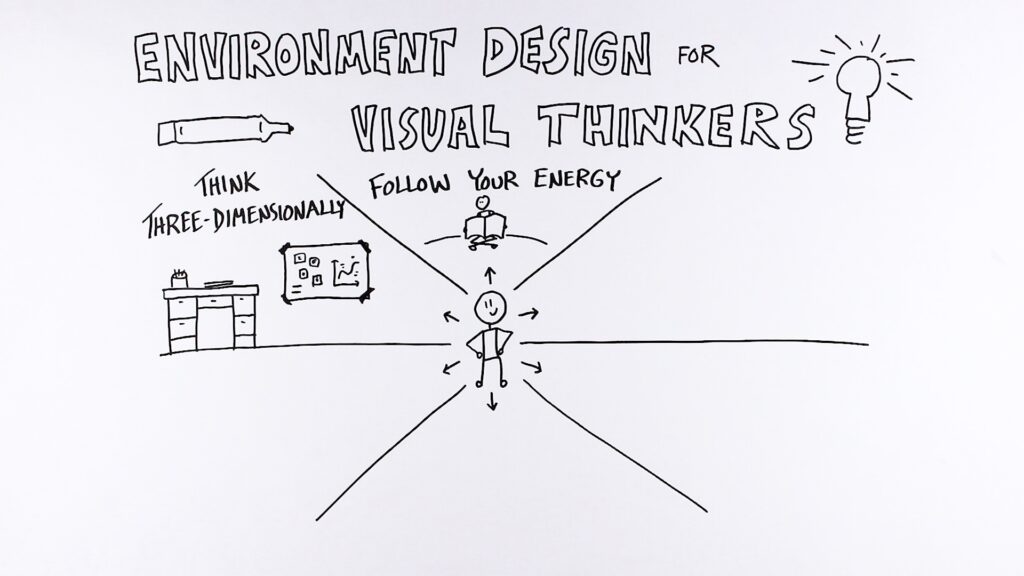
It feels different to sit and work at a desk compared to sitting on the floor, compared to standing up and working on the wall. Each of those locations has its own energy source to it. So throughout the day, I try to follow that energy by making use of the particular space that feels the most energizing in that moment.
There are, of course, a lot of personal preferences that come along with this. So it’s worth paying attention to what sort of setting energizes you and what combination of small settings you might want to create for yourself, so that when you start to feel stagnant in one place, you can shift to another — even if it’s just a few steps away.
3. Lower the Friction
For this next principle, let me describe my desk as a specific example. I invested in a widescreen monitor about a year ago that supports both the video editing that I do and the live visual thinking workshops that I host through Zoom. I’ve also got a high-quality camera set up pointed at my face and another one permanently set up with an overhead rig, shooting what you’re seeing right now. So when it comes time to record a video or to host a workshop, it’s a one-click operation. Everything is in place — I just need to turn it on and hit record.
That’s an example of lowering the friction, of reducing the number of steps that I have to take to get going on my most important work. For those of us who make things, there are already plenty of potential barriers you’re going to have to wrestle with, plenty of sources of resistance that you’ll have to overcome. Don’t let your physical space be one of those sources of resistance.
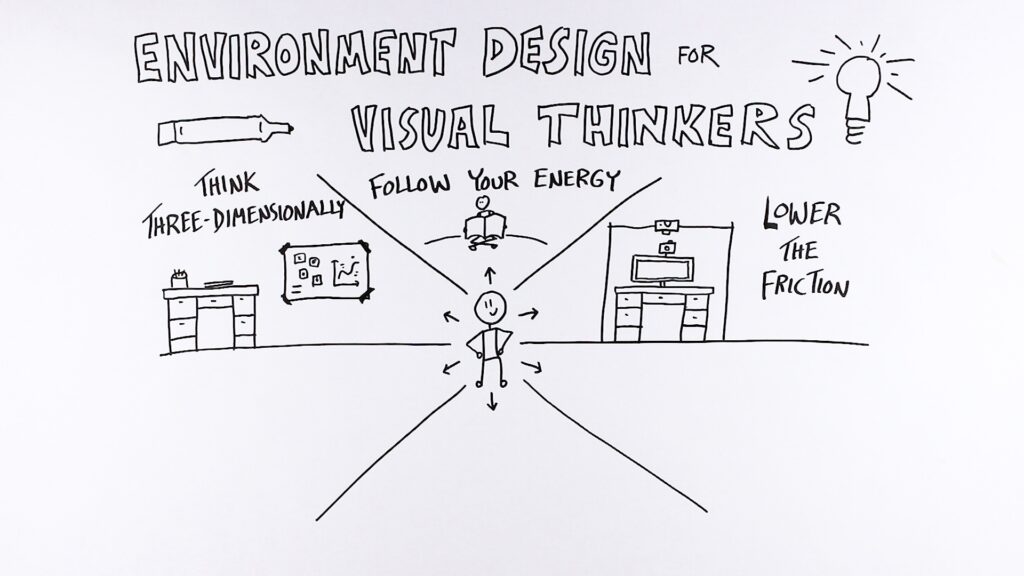
Once you have honed in on the thing that you’re making and the tools that you need to make that thing, make sure those are accessible and, to the extent possible, set up and ready to go. That could also look like having stacks of index cards within reach, or ink refills for your pen in the drawer close by. Whatever you can do to facilitate that transition from an idea to acting on that idea, the better.
And while it’s useful to lower the friction around the things that you want to do more of, it can also be helpful to increase the friction between you and the things that you would like to do less of — like scrolling social media, for example. Maybe when you’re in the midst of a creative work session, your phone lives far across the room. Maybe you use an app like Focus Friend for 20- or 30- or 45-minute work sessions that increase the friction between you and your phone.
4. Reduce the Pressure
I also encourage you to look for ways that you can reduce the pressure surrounding the creative process. One way you can do that is by making use of disposable materials — like legal pads, index cards, and sticky notes — that lower the stakes of any single sketch you’re making, any single chunk of your creative work.
When you have explicit materials and potentially explicit workstations that are designed for brainstorming and experimentation, you allow for the creative exploration that Rick Rubin talks about in his book The Creative Act: where you can try anything and everything and follow your excitement before you narrow your focus by picking the direction that you want to go and crafting the thing from there.
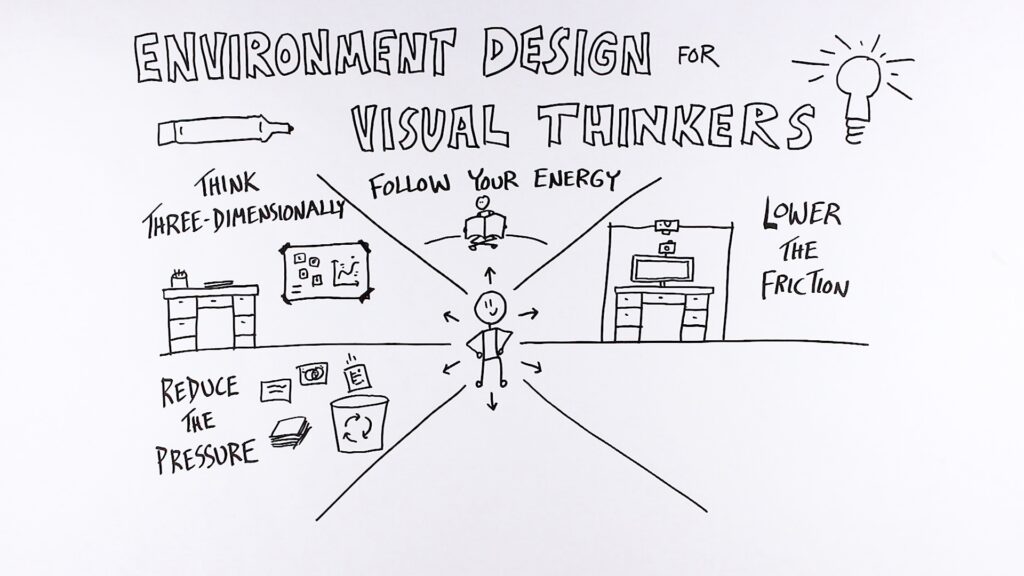
You can unintentionally put a lot of pressure on yourself if you try to jump straight from the seed of an idea to the crafting of a polished product. So make sure you have a workstation and the appropriate materials that support that stage of low-pressure experimentation.
That freedom to experiment is something that Annie Murphy Paul talks about as well. That’s one of the benefits of walls — when you create a sense of privacy, you can make things without someone looking over your shoulder, without a passerby being able to glance at what you’re working on, so that you’re not distracted by what other people think of the work and can instead make something that’s true to you.
5. Craft Your Identity
Annie Murphy Paul also describes how through a built space you can create for yourself a home advantage. Part of that home advantage is about crafting your identity. That could look like reminding yourself of identities that exist beyond this workspace, with photos of your family and friends. But it could also look like reminding yourself of newer identities that you’re stepping into — maybe by hanging up the official “Permission to Suck at Drawing” certificate from Mike Rohde, or maybe it’s picking up a poster of Dave Gray’s Visual Frameworks.
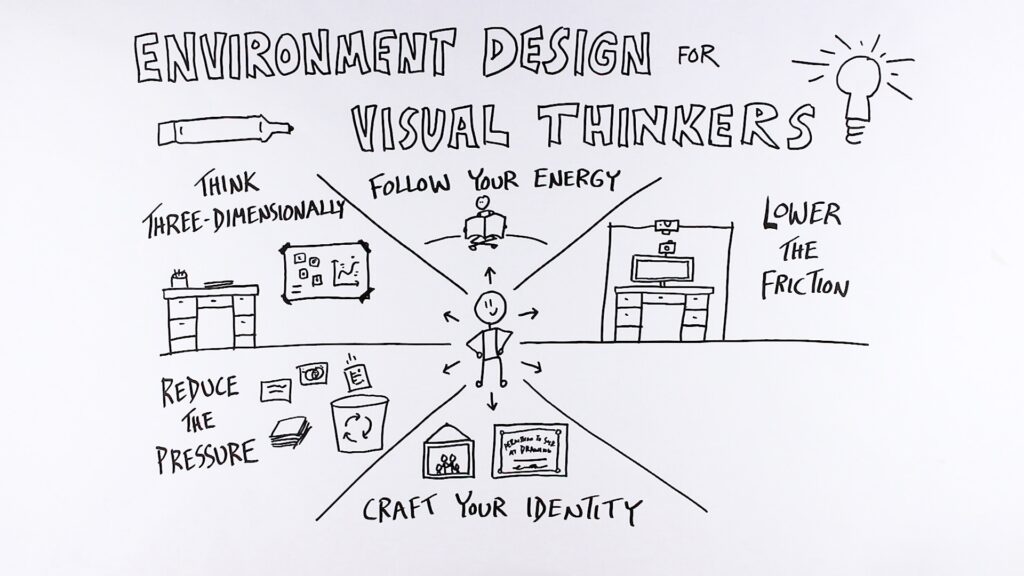
As we learned from the book What Works by Tara McMullin and her discussion of the network self, we each contain multiple identities. At any given time, we can choose which of those identities we’re leaning into. You can use the design of your physical space to support that exploration or development of a new identity — an identity like visual thinker.
6. Extend the Arena
Finally, the last thing I encourage you to consider is what happens when you leave this space. What do you leave behind and what do you take with you? And how might you extend the learning arena beyond this one particular place?
It’s very important to give yourself a break from your work — that’s another important principle from The Creative Act: cycling between doing the work and stepping away. While it is important to leave the majority of the work behind in that space, I do encourage you to bring one thing with you so that you can tap into inspiration as it arises in the other aspects of your life.
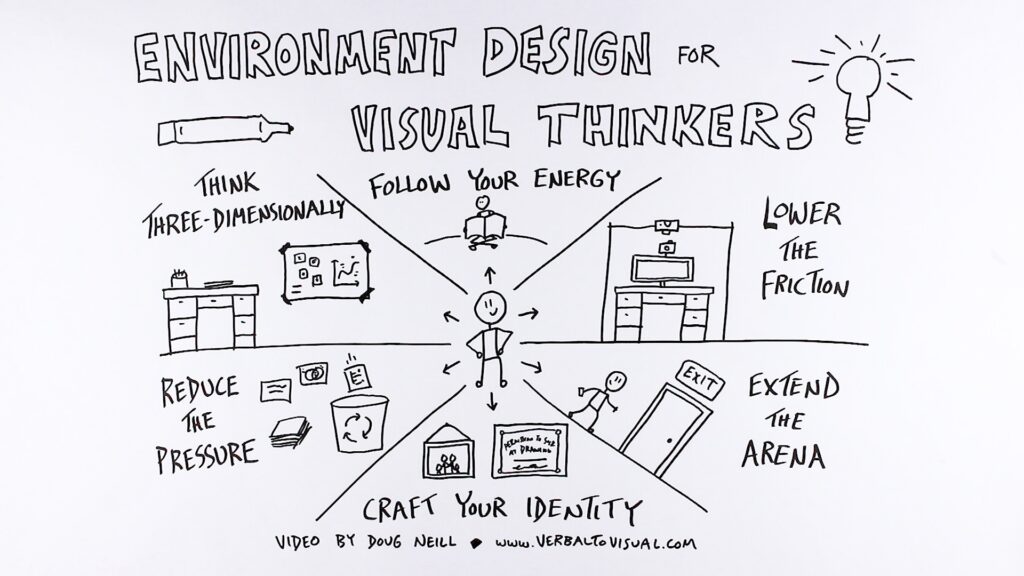
That could look like picking up a pocket notebook to jot down ideas that come to you, or it could be as simple as using the notes app on your phone to capture those ideas. Because once you have created the space to do good work, to place your attention on the work that matters to you and make some progress on it in this physical location, when you leave it, the back of your mind is going to continue working with those ideas without you even trying.
So extending the arena isn’t about cramming a bunch more work sessions outside of the office. Instead, it’s just about creating this space where you can capture those sparks of inspiration that come naturally. Because even if you think you’ll remember that good idea you had, there’s a good chance that by the time you complete your day, have a good night’s rest, and come to the office, you might have forgotten it. So have a place where you can jot it down. That might just be the seed that gives you something to work with the next day.
Putting It All Together
Consider these six principles as you think about the environment that you’ve set up for yourself:
- Think three-dimensionally. Move beyond the two-dimensional page and consider your full space.
- Follow your energy. Create distinct workstations that you can cycle between.
- Lower the friction. Remove as many barriers as possible between an idea and getting down to work on it.
- Reduce the pressure. Create a space and set of materials where you can experiment before you polish.
- Craft your identity. Remind yourself of the you that lives outside of this space and the you that you’re stepping into.
- Extend the arena. Take something with you so you can capture the ideas that crop up outside of this one space.
For more support with the visual thinking work that you do in your space, come join us inside of Verbal to Visual. You’ll find a library of self-paced courses to get you up and running with visual thinking, along with weekly live workshops where you can connect with me, get feedback on your work, and get inspired by the work of other visual thinkers from around the globe.
Cheers,
-Doug