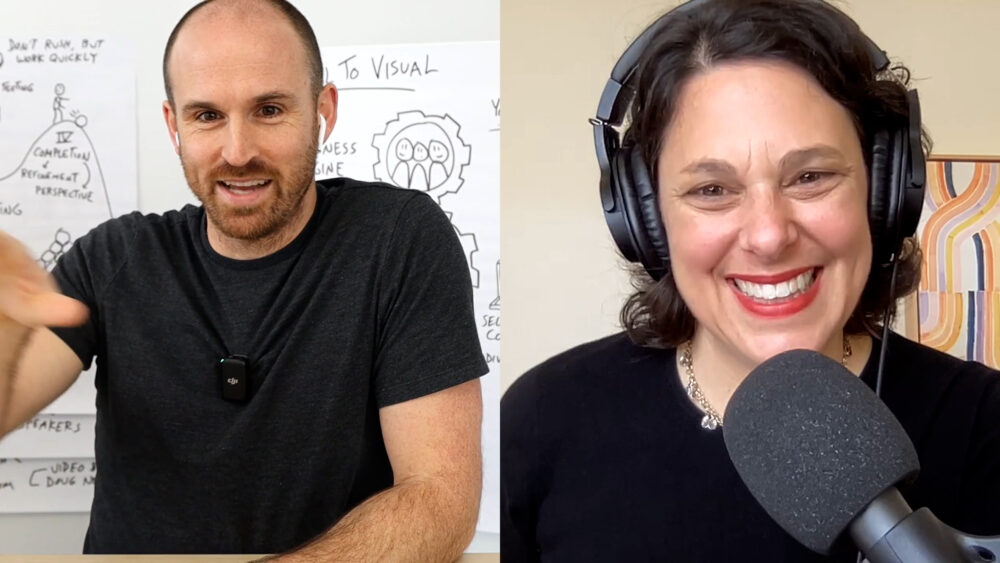
Two years ago I had a conversation with Kathy Oneto on her Sustainable Ambition podcast, and after some recent interactions related to the release of her new book, I’m excited to share the video version of our chat here. Below is an overview of the topics we explored, along with some updated thoughts I share at the end of the video.
How I Got Pulled Into Visual Thinking
The conversation starts with how I found my way into this world. I was substitute teaching in Portland about a decade ago, not quite sure if a traditional teaching career was the right fit for me. One afternoon I watched Sunni Brown’s short TED talk “Doodlers, unite!” which made the case for doodling as a thinking tool rather than an artistic pursuit. That idea clicked for me immediately — especially because I wasn’t someone who considered myself creative or artistic. I hadn’t really drawn anything since second or third grade, when drawing quietly disappeared from my schooling experience.
From there I discovered the concept of sketchnoting through Mike Rohde‘s work, started a blog to document my skill development, and eventually merged my background in education with this growing interest in visual thinking. That’s how Verbal to Visual was born.
Doodlers and Non-Doodlers
Kathy and I talked about the two types of people who tend to find their way into visual thinking: the non-doodlers (like me) who hadn’t drawn in decades, and the doodlers who never stopped sketching in the margins. Each group faces its own challenge — non-doodlers need to get comfortable making marks again, while more artistic folks sometimes need to simplify their drawing so they don’t get lost in the details and miss the bigger picture.
Visual Thinking as a Learning Tool
A big part of our conversation centered on how visual thinking supports learning, especially when it comes to reading books. The process makes reading more interactive and forces you to sit with the ideas — to decide what matters most, to look for overarching themes, and to find a visual gateway into the author’s thinking that you can return to later.
We talked about the process of distillation: how to move from collecting a broad set of ideas to converging on the essence of what you’ve read. The key is looking for common themes or structures that give you something to hook individual ideas onto, and then sketching those out — even if you start with just words and boxes.
Why Visualization Works
I walked through some of the science behind why visual thinking is effective. So much of our brain is dedicated to visual processing, and when we only use words, we’re leaving that processing power on the table. Even simple diagrams like mind maps or flowcharts tap into our spatial reasoning abilities — the same ones we use to navigate physical spaces. When you add drawing into the mix, you activate additional associative networks in the brain (the concept of dual coding), which makes learning stickier and problem-solving more expansive.
There’s also the benefit of cognitive offloading — getting ideas out of your head and onto a page so you’re not limited by working memory. As Annie Murphy Paul describes in The Extended Mind, visualizations become an extension of your brain that makes it more powerful.
The Emotional and Playful Side
Kathy brought up the emotional dimension of visual thinking, and I agreed that there’s a component of playfulness to this work that’s relatively easy to tap into — once you get past worrying about how your drawings look. Bringing in imagery, even simple stick figures or sketches of everyday objects, gives ideas a bit more life than words alone. You can have a conversation with what’s on the page in a way that feels more dynamic than written journaling.
Real-World Applications
We explored the range of ways people apply visual thinking — from personal learning (sketching out books, podcasts, and conferences) to professional settings (taking visual notes in meetings that become valuable shared resources). I shared the story of a community member who sketched out The Psychology of Money specifically to have a conversation with her teenage daughter about finances — using the visual notes as a third thing they could look at together.
We also discussed how sketchnoting skills can open up freelance and career opportunities, including graphic recording and graphic facilitation, where you’re the person at the front of the room sketching out a conference or meeting in real time.
Visual Thinking and AI
Kathy raised the topic of AI, and at the time of our original conversation (spring of 2024) I was just starting to think about it. In my updated commentary at the end of the video, I share where my thinking has landed two years later: AI tools have gotten significantly better at creating infographics and even sketchnote-style illustrations. They can produce a useful visual summary for you. But there’s something fundamentally different between being handed a visual and creating one yourself. It’s the thought, effort, and creativity you put into it that produces the learning benefits and makes the visual stick.
My current approach is to use AI as a support tool — for example, doing a brain dump through a voice recording and then asking Claude for visual suggestions when I’m stuck — but only after I’ve done my own exploring and creating first. The core message: don’t offload your thinking or creativity entirely to AI.
Visual Thinking and Sustainability
Toward the end of the conversation, Kathy asked about sustainability — a word I use often in my work. I talked about how visual thinking can support the pursuit of any ambition by helping you see your commitments and how they fit together. When you sketch out the different components of your identity, your responsibilities, your personal and professional systems, you can see where you’re overcommitted. Once it’s laid out on the page, you can’t deny it anymore.
I also emphasized the iterative nature of this kind of strategic sketching. Your ambition might stay consistent, but what sustainability looks like will change over time, and being willing to re-sketch your systems whenever needed is part of the process.
Updated Reflections
At the end of the video I share a few additional observations from rewatching our conversation: I noticed that I had more energy when standing at my treadmill desk setup (which I no longer use as a primary workstation — something I might change). I mentioned that in the two years since our conversation, I shifted from writing a book to creating the Make Models course, which brings together a lot of the ideas we discussed — directing your visual thinking toward the synthesis stage, where you create cohesive visual models. And I was happy to be reminded of the Six Scoops exercise, inspired by a children’s book I’d been reading to my boys, which has me wanting to revisit their current favorite books with fresh eyes.
Finally, congratulations to Kathy on finishing her book Sustainable Ambition — go check it out, and subscribe to her podcast for more conversations like this one.
And if you’re ready to dive deep on your visual thinking skills, come join us inside of Verbal to Visual to tap into an on-demand curriculum and weekly live workshops.
Cheers,
-Doug