Every January, millions of people set goals. By February, most of those goals have been abandoned.
It’s not because people lack willpower or commitment. It’s because goal-setting, as typically practiced, misses something fundamental about how humans actually live and work.
Jim Hollahan, a member of Verbal to Visual, had experienced this firsthand. As he reflected on past years, he noticed a pattern: he’d set new goals for himself, and they never got implemented. They all fell away.
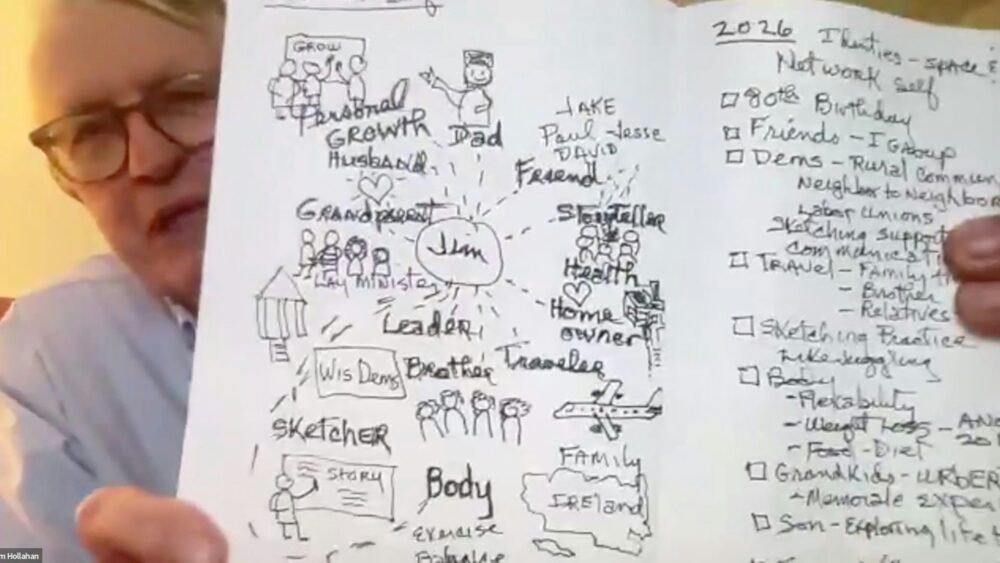
But when he sketched a network self diagram during our annual review workshop a few weeks back, mapping out his different roles and identities rather than listing goals, something shifted. Looking at the roles in his life felt different than his old goal-setting point of view.
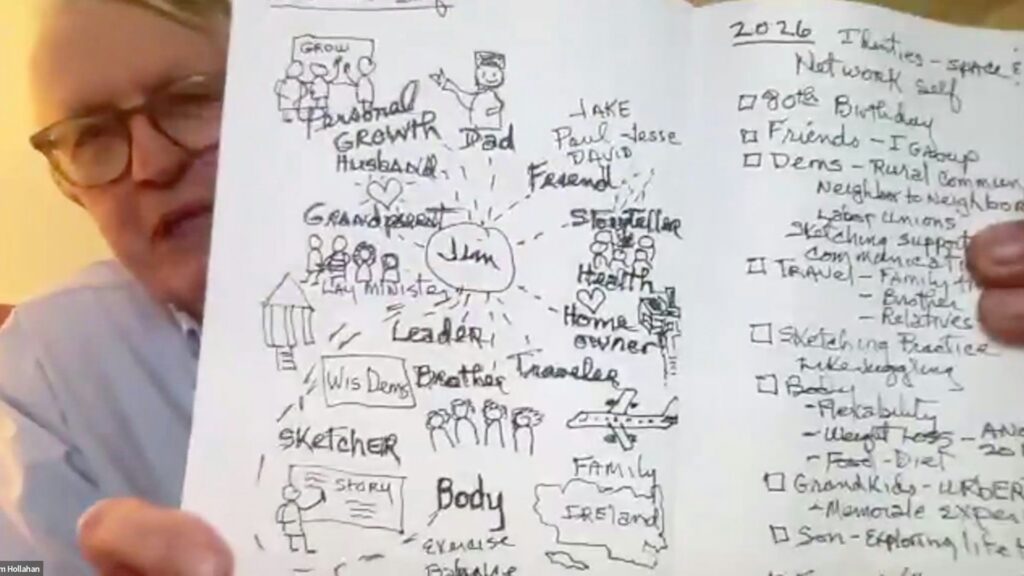
Instead of asking “What do I want to accomplish?” the question is now “Who do I want to be?” And more specifically: “How do I want to show up in these different roles that matter to me?”
Drawing the diagram helped him see relationships he hadn’t noticed before. Connections between roles. Places where his different identities overlapped or supported each other. He described feeling a sense of clarity and a deeper understanding of what he’s doing and where he wants to go.
I first came across the concept of the network self in Tara McMullin’s book What Works. It showed up again, this time under the name of a self-concept map, in Charles Duhigg’s book Supercommunicators.
As Jim noted, when you can see all of your identities instead of thinking just about one, it becomes a question of balance: How do you stay in balance with yourself versus letting an event in your life take over 100% of your attention? When you can see your multiple roles visually mapped out, you notice when things get imbalanced. You can ask yourself: Have I spent 70% of my energy on this one role while neglecting others that matter to me?
The beauty of identity-based planning is that it’s harder to “fail.” A goal is binary: you either hit it or you don’t. But a role is something you inhabit. You can always ask: Did I show up in this role today? Did I put energy toward it? The answer might be yes or no on any given day, but the role itself remains available to you.
So as you think about the year ahead, consider:
What roles or identities do you want to lean into? Focus less on what you want to accomplish, and instead shift your attention to who you want to be.
Sketch out your network self. Put yourself at the center, map your roles radiating outward, and look for the connections. What do you notice about balance? About integration? About which roles are getting energy and which have been neglected?
Sometimes the most powerful shift isn’t in what we plan to do, but in how we think about who we are.
Cheers,
-Doug
P.S. If visual thinker is an identity you’d like to lean into this year, come join us inside Verbal to Visual.