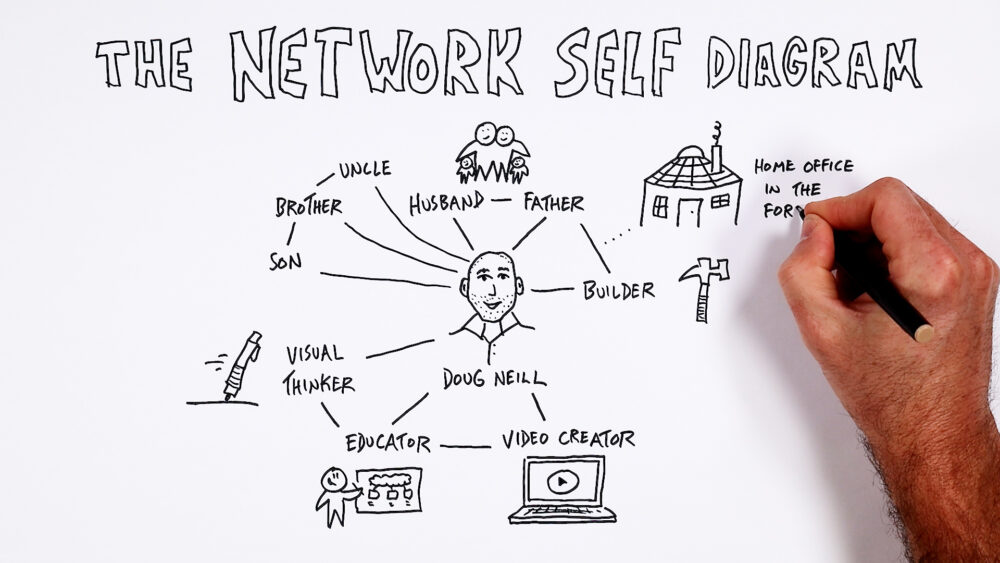
It can be easy to reduce your sense of yourself to a single identity: the one that matters most to you, or the one that’s front and center right now.
But you are more than one thing. You hold multiple identities, and in many situations it helps to remind yourself of all of them. That’s exactly what the network self diagram is designed to do.
In this post I’ll show you how to sketch out this type of diagram and share when and where you might use it.
Where the Network Self Comes From
I first came across this type of diagram in Tara McMullin’s book What Works: A Comprehensive Framework to Change the Way We Approach Goal Setting. Early in the book, McMullin introduces the concept of the network self, which comes from philosopher Kathleen Wallace.
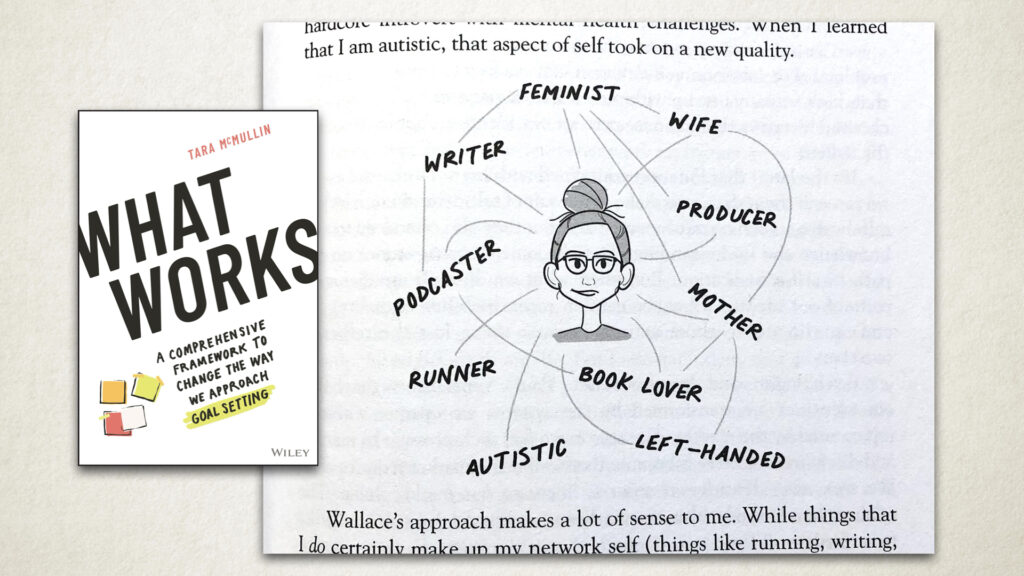
In the context of goal setting, the idea is to acknowledge your multiple identities (maybe including new ones you’ve taken on recently) and explore how they’re connected. That helps you decide which identities you’d like to lean into in the coming months.
In the busyness of modern life, it’s easy to push some of our identities aside and not give them the attention they deserve. Naming your identities explicitly can help you decide which ones deserve more time on your calendar.
Goal setting isn’t the only use for a network self diagram, though. Let’s explore a few more as I sketch out mine, and I encourage you to sketch out yours alongside me.
How to Sketch Your Network Self Diagram
1. Start with a simple self-portrait
Put a simple self-portrait in the middle of the page. Don’t worry about making it look realistic. Just capture the rough shape of your head and hairstyle, plus a few details like glasses or the shirt you usually wear.
2. List your family identities
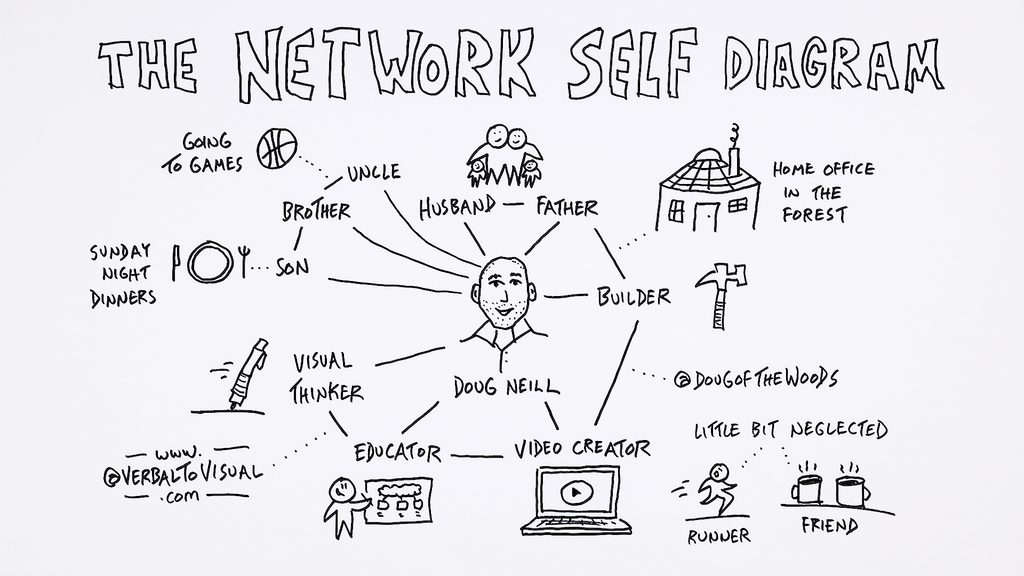
Next, start listing your identities. Family is a good place to begin. I am a husband and a father, and I sketched our family as simple star people. I’m also a son, a brother, and an uncle.
For some or all of your identities, you can add a quick icon or scene that represents it. That helps bring each identity to life in a bit more detail.
What are your family identities?
3. Add your professional identities
Next, look at your professional identities. I am a visual thinker, an educator, and a video creator. I make public videos for YouTube, and I also build online courses for people who want to go deeper with the skill of sketching out interesting ideas.
What do you do? What identities are involved in your work?
New to sketching out your ideas? If you’d like more practice sketching things out instead of just writing them down, check out the free guide Getting Started with Sketchnoting. In it I share my overall philosophy behind this kind of work, along with specific practice activities so you can get a feel for it yourself.
4. Include newer identities, too
A more recent identity of mine is builder. Last year I built a small shed to house our generator for when the power goes out, which tends to happen a few times each winter. This year I’m building a home office in the forested part of our property here in Oregon.
Adding Projects and Traditions
That home office is an example of a specific project connected to one or more of my identities. You can add projects like this as a second ring around your interconnected list of identities.
I placed my sketch of the office where my builder identity meets my family identities, because it’s tied to my home life. My kids are watching me build it and sometimes helping. They’ll have access to the space too, maybe doing homework alongside me or coming up to read on the weekend.
At first I wasn’t publicly documenting the build, but I was taking photos and recording short videos along the way. As the project progressed, I got the itch to bring my video creator identity to it. So I started a new account called Doug of the Woods (on YouTube, Instagram, and TikTok) to share the building of the forest office, and probably future projects too, like establishing a food forest in those same woods.
The project where my visual thinker, educator, and video creator identities meet is, of course, Verbal to Visual. It has public channels like YouTube, and private ones like our online learning community, which provides the financial backbone for this work.
Traditions can go on the page as well:
- As a son, I think of our Sunday night dinners with my parents. Hosting duty alternates between their house and ours.
- As a brother and uncle, I think of catching my niece’s and nephew’s soccer and basketball games on the weekends, and of them coming to my kids’ games.
Once you’ve listed (and maybe sketched) your identities and how they connect, ask which projects or traditions support those identities, and add them to the page.
Noticing Neglected Identities
As you go, you may realize that some identities you have, or once had, are getting neglected right now. It’s worth putting those on the page too, as a reminder of where you might invest your time and energy when opportunities come up.
For me, one of those is runner. Running has been pushed aside lately, mostly because of the home office build. I get decent exercise hiking up and down the hill to the build site, but I miss running and want to get back to it.
The same goes for friend. I feel pressure to finish the office before winter, and since that fills most of my free time, I’m less likely to reach out to friends to hang out.
This also creates a chance to blend my builder and friend identities by inviting friends over to help with the build. I’ve done a bit of that, but I could do more.
That’s one of the real benefits of seeing all your identities laid out this way. You may spot chances for overlap, ways to live out several identities at once, that you would otherwise have missed.
How’s your network self diagram coming along? Have any insights come up for you through this process?
Examples from the Community
Here are a few more examples of this diagram in action, to show where else you might take it.
Julie: Network self + Gantt chart
Julie’s example may look familiar if you saw my last video on the Gantt chart. A Gantt chart is a project management tool usually used to list and track all the tasks in a project, especially tasks that run at the same time or depend on each other.

During a planning session I hosted, Julie first created her network self diagram. Then she listed each of those identities on a Gantt chart to see which ones would get to be expressed through the projects and activities she planned for the coming months. It’s a great way to be even more explicit about the time and attention you give each identity.
This network self + Gantt chart combo could be worth trying, especially if you’re doing an annual review or reflecting and planning during a time of transition.
Jim: From goals to roles
Community member Jim listed and sketched his identities during a different annual review workshop I hosted.
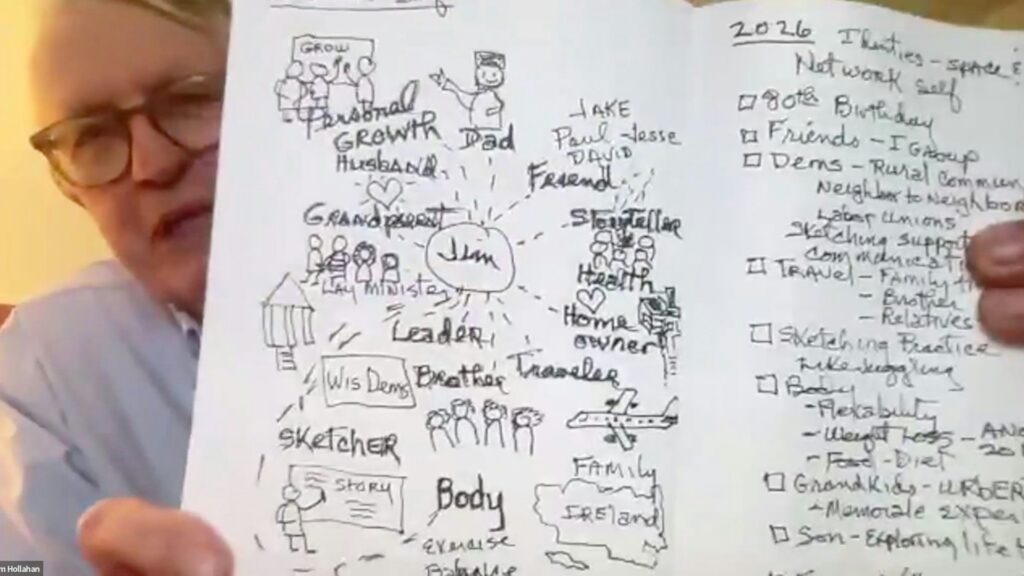
In the process, he saw the value of shifting from listing goals to mapping roles. That shift from goals to roles changes the question from “What do I want to accomplish?” to “Who do I want to be?”, and more specifically, “How do I want to show up in the different roles that matter to me?”
Those are questions worth asking yourself, too.
The Self-Concept Map in Supercommunicators
This type of diagram also appears, under a different name, in Charles Duhigg’s book Supercommunicators, which is about how we can best connect with others through our conversations. One of the three kinds of conversation Duhigg covers is the social conversation, which addresses the question “Who are we?”
Our differing identities can often lead to conflict. Duhigg describes the benefits of creating a self-concept map that draws out your multiple identities, beyond the one that may be at the forefront of a given conversation.
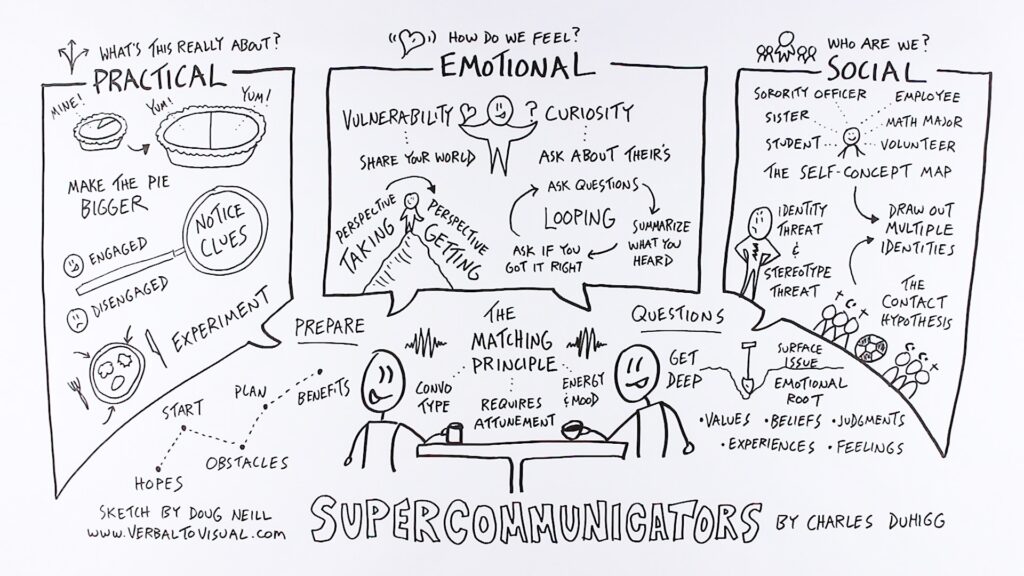
When everyone in a conversation does this first, you can build connection over the identities you share before you explore the ones that may be causing conflict. That lets you address the conflict more productively.
There’s another benefit as well. If one of your identities carries a negative stereotype, the mere existence of that stereotype can undermine performance. Studies have shown, though, that reminding yourself of all your identities acts as a buffer against the stereotype and reduces its impact on your performance.
Why This Matters
How you think about yourself shapes how you approach the challenges and opportunities you meet in daily life. Our focus often narrows to just one identity, and we forget about the others.
Sketching out your identities, looking for connections between them, and finding projects that let you live out one or more of them can help you live a fuller life.
Share Your Diagram
If you created your own network self diagram, I’d love to see it, and I might feature it in a future video.
Like my last video on the Gantt chart, this one is part of an ongoing series where I introduce a specific diagram or visual metaphor you might find useful in your own visual thinking work. I’d love to end future videos with community examples of formats from earlier in the series.
- Already a Verbal to Visual member? Share your sketch here.
- Not a member yet? Explore these resources. Any of our online courses will get you into our online learning community, where you can share your work, get feedback, and take part in challenges like this one.
I hope this look at the network self diagram has been useful. Good luck creating your own!
Cheers,
-Doug