
When you’re learning something new or working through a tricky problem, it’s easy to get overwhelmed by the complexity of the topic and the number of details that you have to keep in mind. In the video above (and post below), I’m going to share with you some simple tools and a specific approach that can help you manage that complexity. Let’s get into it.
I’m on a mission to bring visual thinking on par with reading and writing as a fundamental skill that can help you make sense of your world and thrive within it.
And there might be no better entry point into the world of visual thinking than the humble index card and sticky note.
What Is Visual Thinking?
Before we get into the use of those tools, let me tell you what I mean by that term visual thinking. Even though that term includes the word “thinking,” it’s actually about getting ideas out of your head and onto some sort of external surface.

It’s about making marks (not just words, but also quick little sketches that tap into the visual processing powers of your brain) on your way toward making models (where you bring those ideas together into a cohesive drawing or diagram that organizes the set of ideas you’re working with) for the purpose of making sense (that cognitive spark of “Oh, I see it, and I get it now”) and making meaning (where you feel it too, which makes it more likely that you’ll act on those ideas).
So our goal as visual thinkers is to make marks that help us think through complicated topics. But where do those marks take place? Yes, you could use a notebook or poster paper. Those are useful tools. But there’s something special about index cards and sticky notes that make them particularly useful. Let me share an example to show you what I mean.
Example: The Creative Act by Rick Rubin
When I read The Creative Act by Rick Rubin, I started by simply underlining the passages that stood out to me, sometimes making little notes in the margins. I did that throughout the entire book, reading and underlining the phrases that resonated with me.
But I didn’t stop there. I knew I needed to pull the ideas out of the book and create something for myself, my own visual reference to those ideas. Otherwise, I’d be unlikely to remember them and incorporate them into my own creative work.
And so I turned to sticky notes.
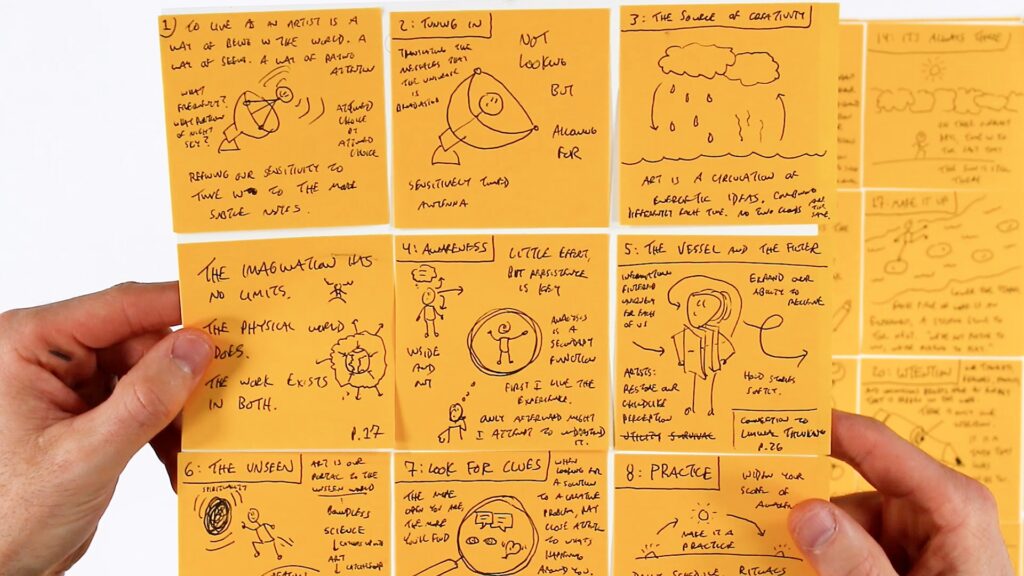
Since each chapter within that book is pretty short, the size of a sticky note made for a great constraint to capture the core idea from that chapter with at least one small visual and a bit of text. I did that for each chapter and just stored those sticky notes chronologically on a piece of nine-by-twelve paper, giving me my own condensed breakdown of the wisdom that Rubin shares throughout that book.
But as you can probably tell, that’s still a lot of info. Yes, I can focus in on any one of those sticky notes to remind myself of the core idea from that chapter, but I hadn’t yet made a model. I made lots of helpful marks, but I was still interested in bringing those ideas together into something a little bit more cohesive.
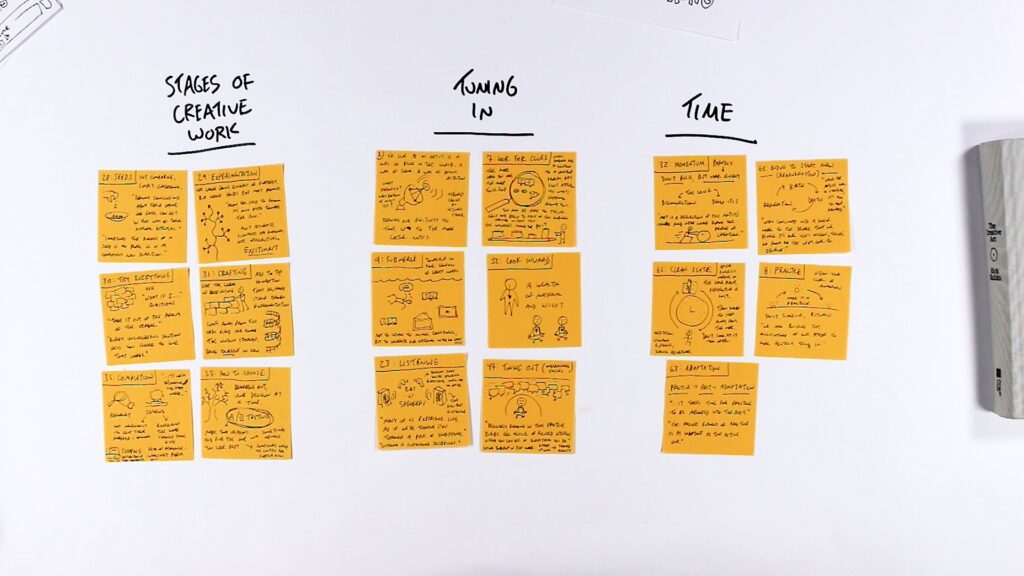
I did that by looking over all of those sticky notes and identifying a handful of themes: one being the stages of creative work, another being this concept of tuning in, and the third being time. Those three topics show up throughout the book. So I simply revisited each sticky note, pulled out the ones that were related to one of those three themes, and grouped them in that way.
The next step was to go about making a small model for each of them, which is what you saw me sketch out if you’ve seen my video about that book.
The Sketch It Out Framework
Here’s another way of describing that process, what I call The Sketch It Out Framework, which is a specific process that I teach within the Verbal to Visual Curriculum.

It involves three main stages. First, defining your purpose: why is it that you’re engaging with these ideas in the first place? Then you collect the pieces: that’s where the sticky notes and index cards come in handy as you pull out the relevant details. And then you bring those details together by solving the puzzle as you make some sort of a visual model, one that lives somewhere along the spectrum from a diagram (like a flowchart or a timeline or a Venn diagram) to a drawing (like a scene or a visual metaphor).
The thing about making models is that it’s hard to go straight there. It’s hard to go straight from defining your purpose to making a model, because you have to know what you’re working with. You have to identify the building blocks of the topic you’re working with.
Why Sticky Notes and Index Cards Work
To see why sticky notes and index cards make for great building blocks, let’s revisit the book The Extended Mind by Annie Murphy Paul, a book that identifies the variety of ways in which you can think outside of the brain by using embodied cognition, situated cognition, and socially-distributed cognition.
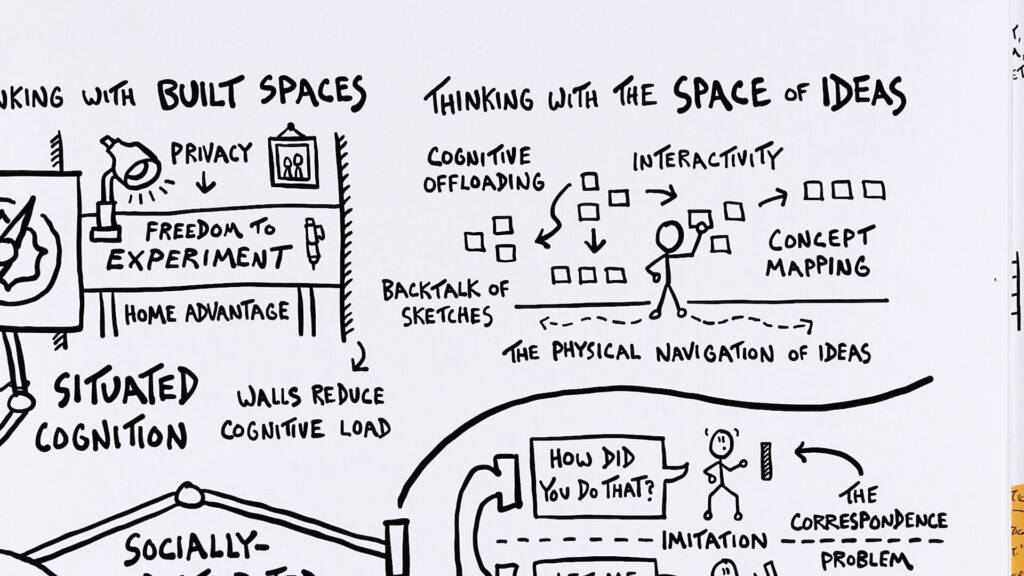
For us here, the relevant techniques land in situated cognition — specifically, thinking with the space of ideas. Here Paul talks about the benefits of getting ideas out of your head and onto some physical surface that you can interact with, to overcome the limitations of your working memory. There are only so many details that you can keep in mind at once. But when you give each of those ideas a physical location on a sticky note or an index card, you’re able to extend your brain’s processing power, map out how those ideas are connected and navigate them physically as you move around the room, or as you reorganize those ideas on your desk.
As Paul writes, “True human genius lies in the way we are able to take facts and concepts out of our heads, using physical space to spread out that material, to structure it, and to see it anew.”
That’s what you get to do with sticky notes and index cards.
Choosing the Right Size
If each chunk that you’re working with is fairly small, then the standard size of sticky note is a great way to go. But what if you want to work with a little bit more information at a time, if you want to have bigger chunks, bigger building blocks?
In that case, let me reference The Idea Shapers by Brandy Agerbeck, which is a great resource for visual thinkers. One of my favorite parts of that book is a section on the anatomy of a card.
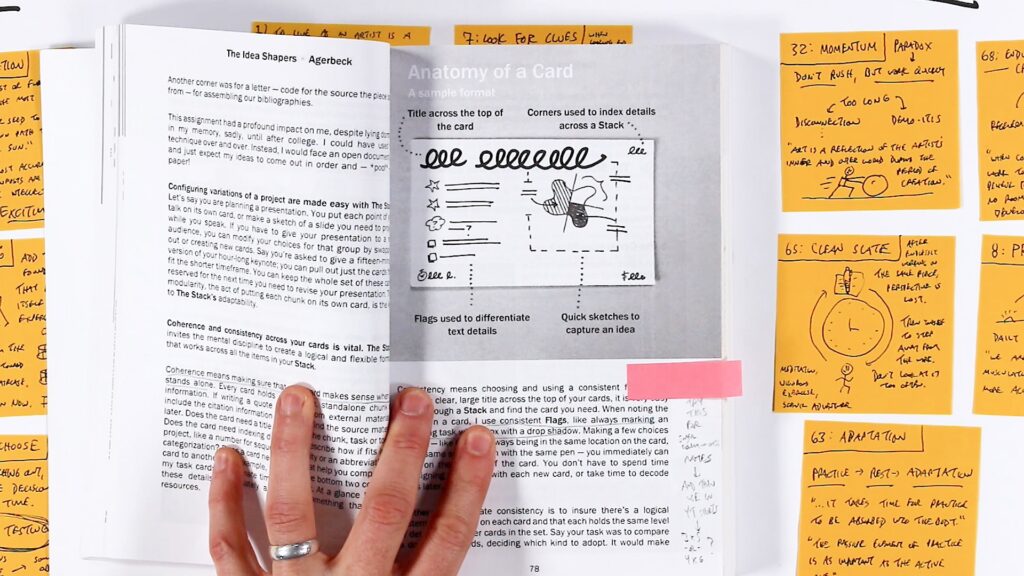
Before reading that book, I’d used sticky notes plenty of times, and I’d used three-by-five index cards. But it’s surprising how much of a difference it makes to jump up from three-by-five to four-by-six.
This difference in size allows you to treat each card as its own mini framework, where you can capture not just a singular idea but a topic by giving that card a title, including some sketches, adding some details, and using the corners for page number references or other details you want to capture.
Example: Supercommunicators by Charles Duhigg
I decided to apply that technique to the collect the pieces stage while I was reading the book Supercommunicators by Charles Duhigg.
As with The Creative Act, I started by simply reading and underlining, working my way through the whole book. But then when I came back to revisit those underlines, because there was a different layer of density per chapter compared to The Creative Act, I used four-by-six index cards to identify the key topics and capture some of those details with sketches and words and page references.
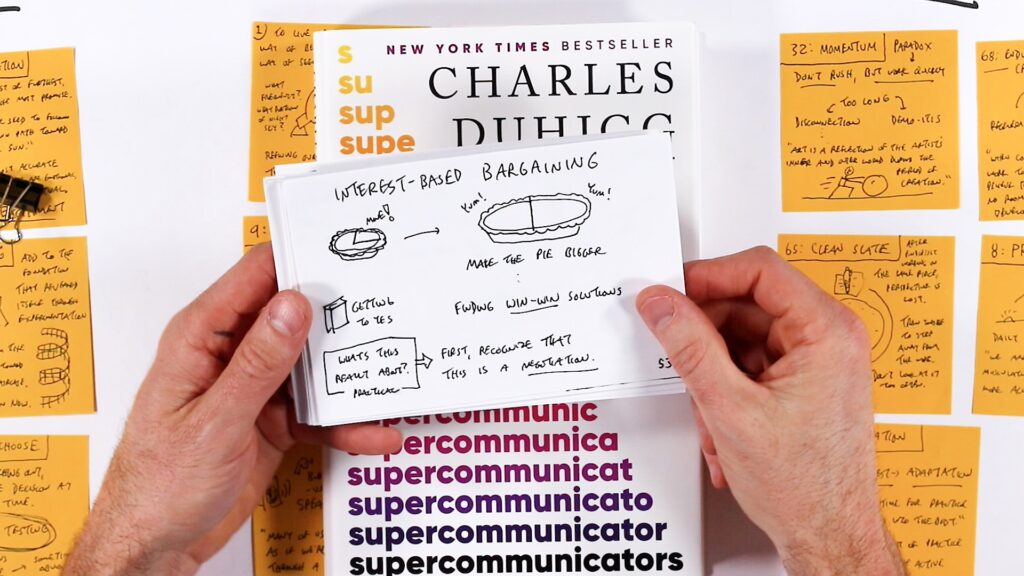
Details like interest-based bargaining, the steps of practical conversations, how to develop an emotional connection, perspective taking versus perspective getting, looping for understanding, battling over control, asking deep questions, and what to do in a conflict.
Similar to the sticky notes, each of those cards is useful on its own, but they become more powerful when you can bring them together into a larger visual structure.
You can check out the structure that I used by watching my video about that book, where you see two people having a chat over coffee, where I’ve used speech bubbles to explore the three types of conversations: practical, emotional, and social. And in many cases, the visuals that you’ll see there came directly from my index cards.
Give It a Try
So the next time you’re trying to wrap your head around a complex topic, maybe through a book that you’re reading, or a problem that you’re trying to solve at work, or even a presentation that you need to give to others, try using index cards or sticky notes as your building blocks to first capture the individual pieces and then experiment with how those pieces fit together.
I think you’ll benefit both from the modularity of these tools (how you can move them around) and also the disposability of them. If you don’t like how one index card or sticky note turns out, you can recycle it and then quickly grab another one. Each of those individual chunks is a much lighter lift than trying to capture, all in one go, everything about the topic you’re working on.
And while you will get some benefits by just adding words to your sticky notes and index cards, you’ll be missing out on some of the visual processing power that you get when you add simple sketches and diagrams.
For more support adding drawings and diagrams to your notes and using them as a deep thinking tool, check out our library of courses that will get you up and running with these skills.

Within those self-paced courses I’ll help you build your skills from the ground up so that you can apply them to the work you care about.
Cheers,
-Doug