Why does the US only have two major parties? That’s a question recently explored by Crash Course with host Kousha Navidar. In this video, I sketch out some of the highlights of that episode:
Mapping Political Parties
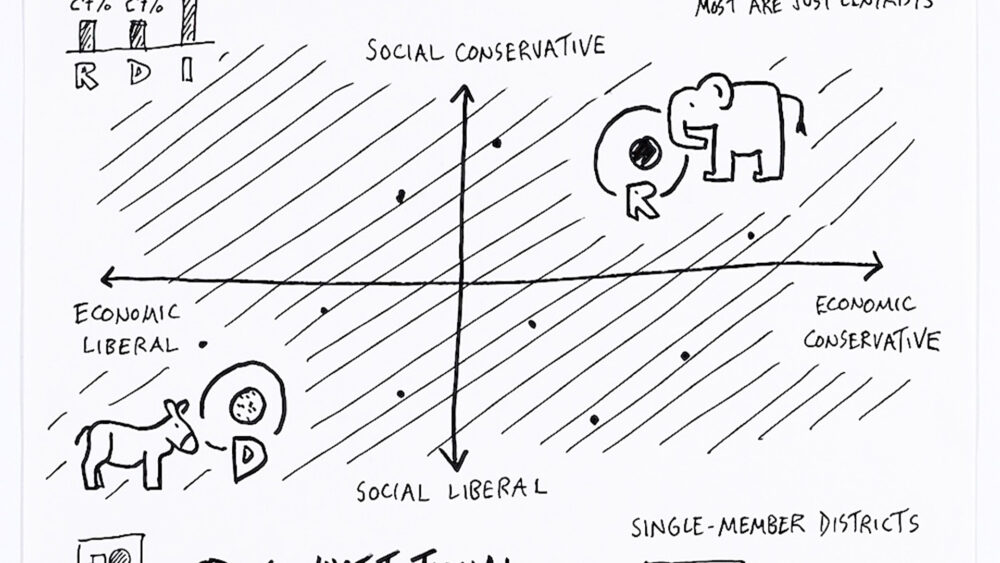
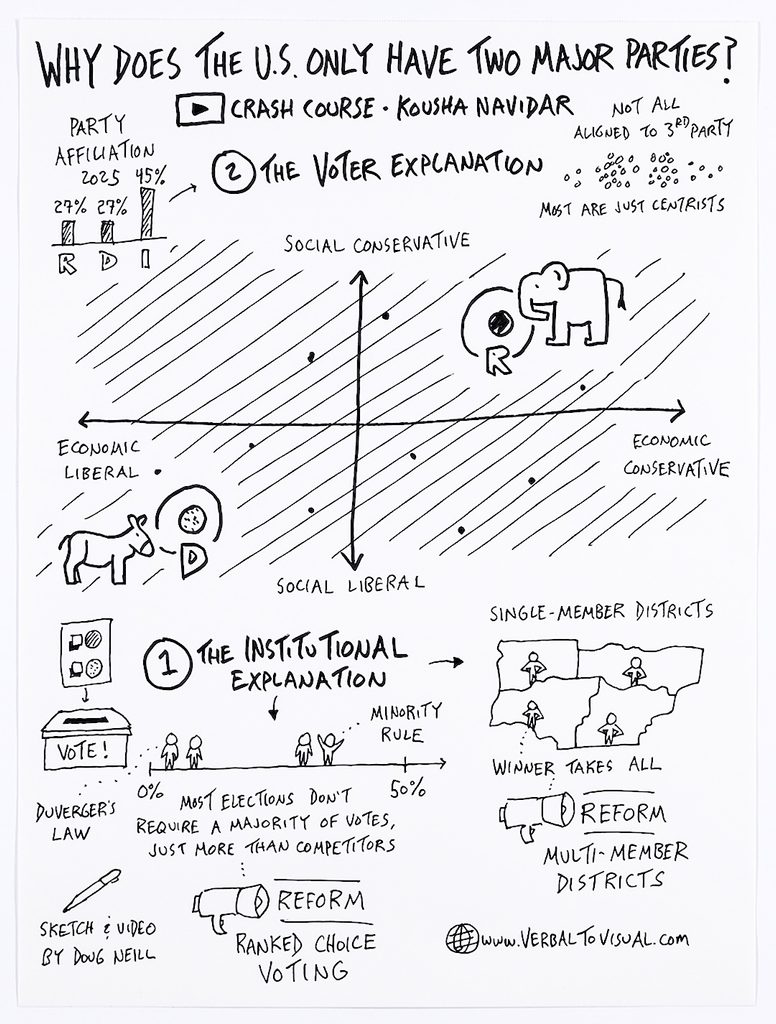
One way to understand political parties is to place them on a chart:
- The vertical axis spans from socially liberal to socially conservative.
- The horizontal axis spans from economically liberal to economically conservative.
In many countries, like Sweden, you’ve got parties all over this chart. In the United States, however, we’ve been locked into just two major parties for quite some time: Republicans, who live on the conservative side of both spectrums, and Democrats, who live on the liberal side.
But why only two? That’s especially puzzling when you consider that party affiliation polls have shown that 45% of the population identifies as independent.
Navidar outlines two explanations.
Explanation #1: The Institutional Explanation
This explanation argues that our election process boxes out third parties. It does that in a few ways.
Winning without a majority. The winning candidate doesn’t need a majority of the votes (over 50%). They just need more votes than their competitors. Because of that, you often get minority rule, where voters are represented by someone that only a fraction of them actually supported.
Duverger’s Law. This same setup hinders third parties through Duverger’s Law, which states that people are unlikely to vote for a third-party candidate, even if they like that candidate best, because the candidate’s chances of winning are low and they don’t want to waste their vote.
Single-member districts. These are geographic areas that are each represented by a single elected official, which results in a winner-takes-all outcome.
Explanation #2: The Voter Explanation
This explanation takes a closer look at that independent 45%. If all of those independents were aligned with a third party, that would change things. But of course, that’s not the case.
Independents also fall along a spectrum, but most of them are clustered toward the center and end up aligning mostly with either the Democratic Party or the Republican Party. So that’s who they vote for.
As a result, this map of political ideologies gets reduced to two small, occasionally shifting islands, each occupied and ruled over by one of the major parties.
Two Reforms That Could Change Things
Thankfully, this system isn’t set in stone. Two reforms could dramatically change things:
- Ranked choice voting
- Multi-member districts, replacing the winner-takes-all approach
Together, those reforms would make it more likely that a third party could gain a foothold. They would also help create a system where elected officials more accurately represent the beliefs and priorities of their constituents.
Up Next
Stick around for the next episode in the series, where we’ll explore where campaign money really comes from.
Want to learn how to take visual notes like the ones you see here? Check out these resources.