When you hear the term welfare abuse, who comes to mind?
You might think of someone trying to game the system: seeking out benefits they don’t need, being lazy, and wanting handouts.
But as More Perfect Union recently reported, it’s not the people seeking support who should concern us. Instead, it’s the surprising number of non-government contractors and consultants who are running the system.
Let’s break it down.
You can also watch the hand-sketched explainer on YouTube and TikTok.
What Welfare Is Supposed to Do
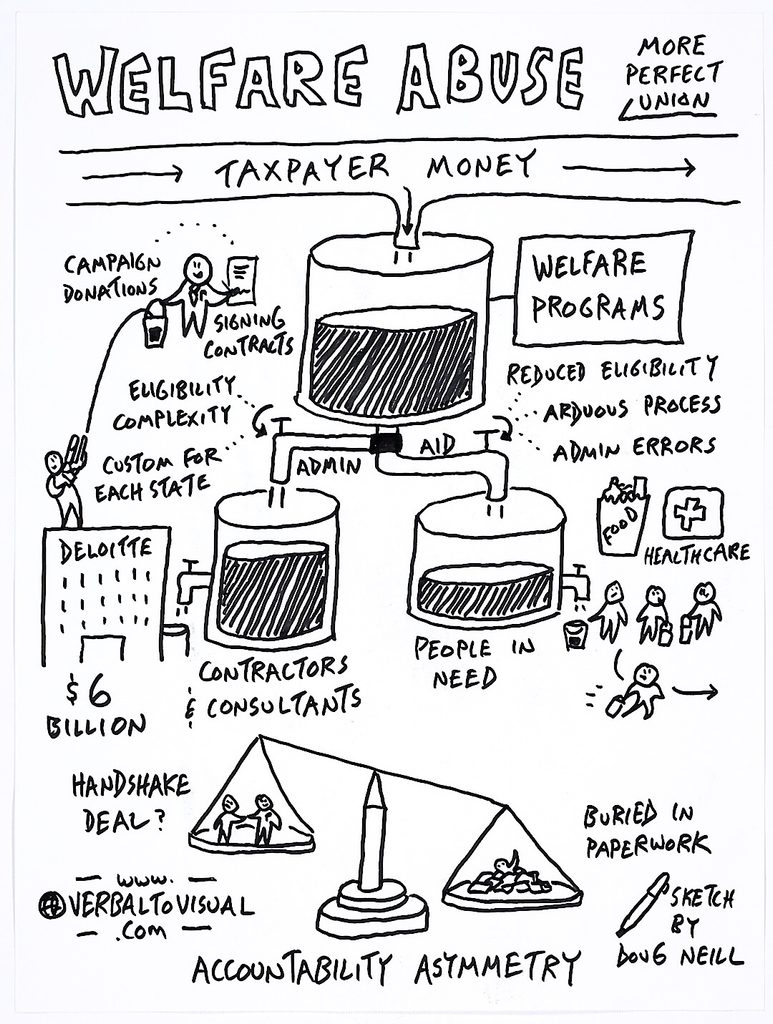
The whole purpose of directing some taxpayer money into welfare programs is to help people in dire circumstances buy food and access health care. These are basic human needs.
Where the Money Is Going Instead
In the United States, money is being siphoned away from that purpose. Non-government contractors and consultants are hired to build and maintain the systems people use to apply for these programs, and in the process, they determine who receives benefits and who doesn’t.
Deloitte is one example. The company has been awarded $6 billion in government contracts, and it also happens to have donated to the campaigns of the same legislators who award those contracts.
What Keeps the Tap Open for Contractors
Several parts of the system keep the money flowing toward contractors like Deloitte:
- Complex eligibility rules. These became even more complicated after the One Big Beautiful Bill passed.
- More frequent eligibility checks. The same bill increased how often eligibility requirements must be verified.
- State-by-state systems. These programs are built separately for each state and territory, and taxpayers pay full price for every one.
That raises the question: Why not bring this work in-house, build the system once at the federal level, and then let the states use it?
What Restricts the Flow to People in Need
At the same time, the flow of support to people who actually need it is being restricted by:
- Stricter eligibility requirements
- An arduous application process
- Administrative errors within that process
Together, these lead to eligible applicants being denied access to the programs designed to help them.
A Stark Asymmetry
What we’re seeing is a stark difference in how applicants are held accountable compared with the contractors and consultants handling the administrative work. The contractors seem to cruise by on a handshake deal, while the people in need get buried in paperwork.
As one commenter on More Perfect Union’s video put it: “US citizens are paying taxes to private companies to deny them healthcare.”
So maybe it’s worth paying less attention to supposed “welfare queens” and more attention to the companies and legislators who are siphoning taxpayer money away from the people who actually need it.
Want to learn how to take visual notes like the ones you see here? Check out these resources.