What’s the best way to get started learning a new skill? That’s the question Josh Kaufman explored in a TEDx talk called The First 20 Hours. In this video I sketch out some of the main ideas from that talk and apply them specifically to learning the skill of sketchnoting, a form of visual note-taking that combines quick sketches alongside helpful phrases.
The Improvement Curve
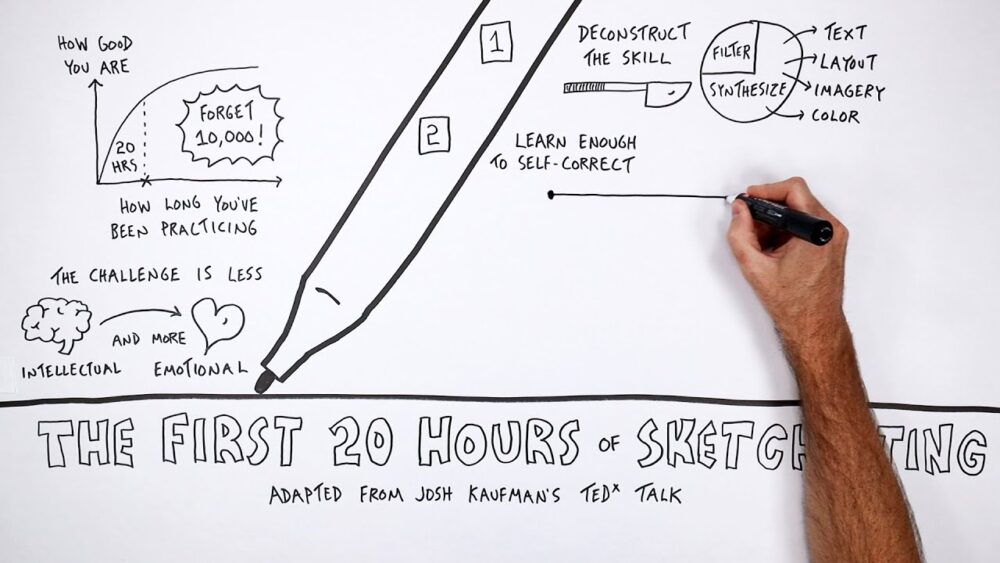
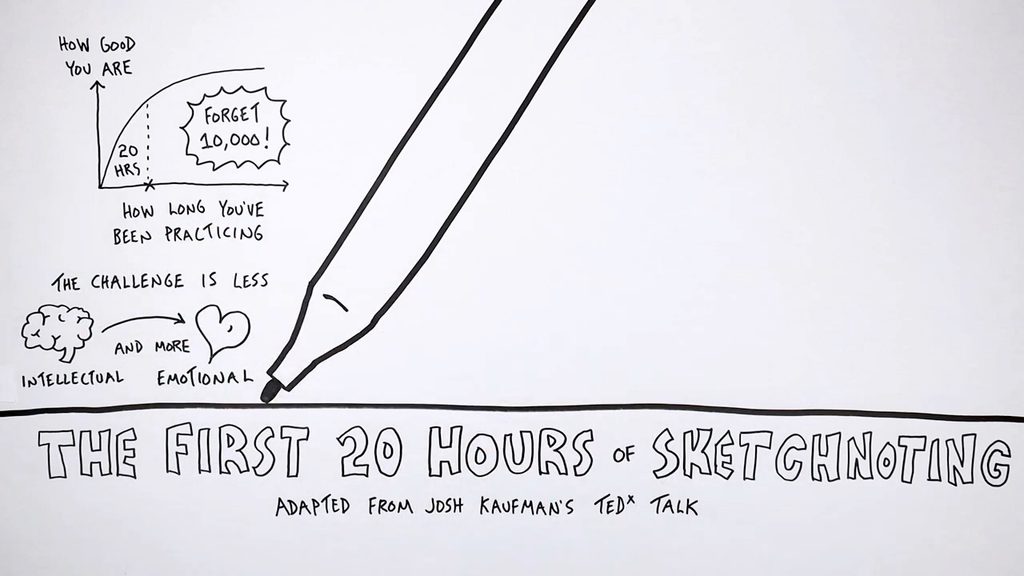
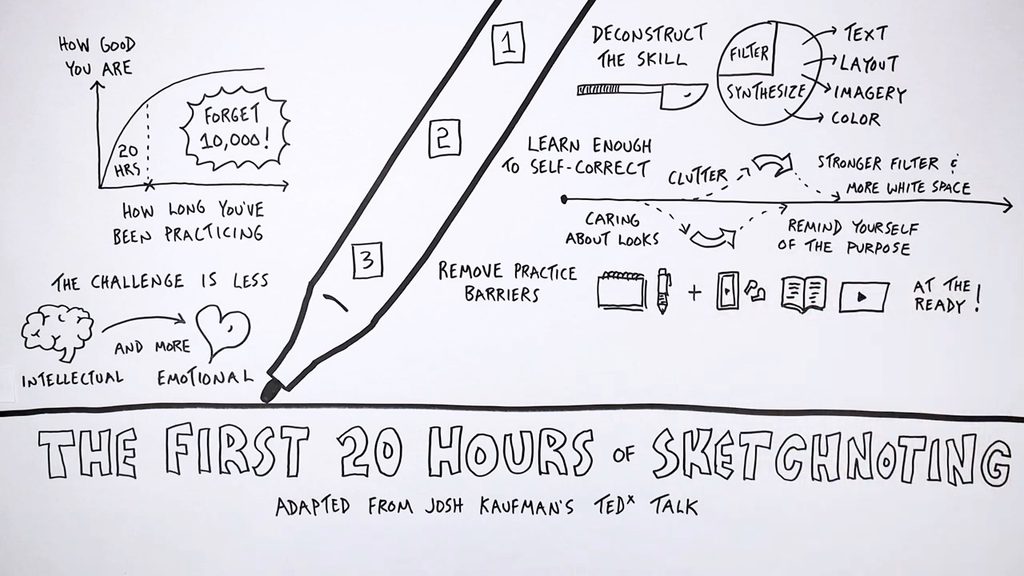
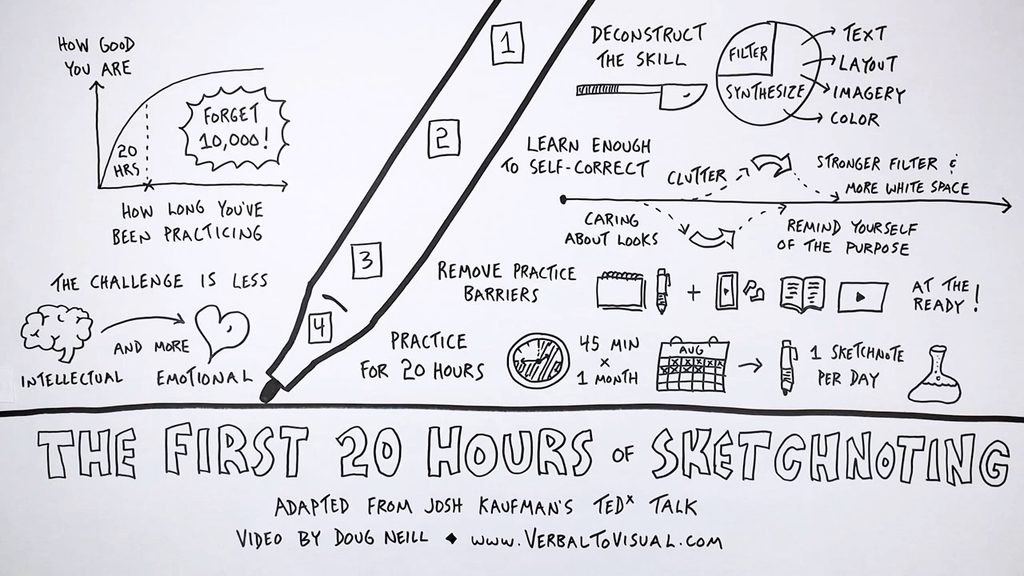
One of the first things Kaufman talks about is the relationship between how good you are at something and how long you’ve been practicing it. The curve looks something like this: initially you see pretty rapid improvement, which then starts to taper off, to the point where more practice makes you a little bit better but nothing near those initial gains.
Kaufman’s primary thesis is that you can get decently good at something within just the first 20 hours of practice. This stands in stark contrast to the 10,000 hours you might be familiar with from Malcolm Gladwell’s work. Kaufman points out that the 10,000-hour figure only applies to elite performers in highly specialized fields. For most of us and the skills we’re developing (whether it’s sketchnoting or something else) we’re not shooting for that elite level, and it’s probably unlikely that we’re going for a highly specialized field. So it’s kind of reassuring to know that within a relatively short period of time, just 20 hours, we can go from zero proficiency in a skill up to something that’s pretty good.
The Biggest Barrier is Emotional, Not Intellectual
Kaufman also makes the point that the most challenging aspect of learning a new skill isn’t intellectual. We’re all plenty smart enough to work through the problems we encounter. Instead, the challenges are emotional. It’s the feeling of discomfort when learning something new that can be the biggest barrier for us.
I think that’s especially true when there’s something about the skill you’re developing that’s easily judged. Kaufman shares the example of learning to play the ukulele, and music is one of those skills where you can tell just by listening how good someone is or isn’t. That’s what’s emotionally scary about learning to sing or play an instrument.
Sketchnoting can have that same dynamic, because what we’re doing is creating a visual artifact of something we learned. That includes drawings, which are all too easy to critique, especially if you think your drawings need to have some sort of artistic quality to them. But that desire for artistic notes, as opposed to simply helpful visual communication, is one of the ways your first 20 hours spent sketchnoting can go wrong.
But I’m getting ahead of myself. Let me first share the four-step process Kaufman outlines to help you make the most of these first 20 hours.
Step 1: Deconstruct the Skill
If the skill is an entire pie, how was it sliced up? What are the individual components that make up that skill?
With sketchnoting, I think there are two primary components. About a quarter of the process is all about filtering. As you’re reading a book, listening to a podcast, or watching a video, you’re deciding which ideas are worth capturing, which are the most important.
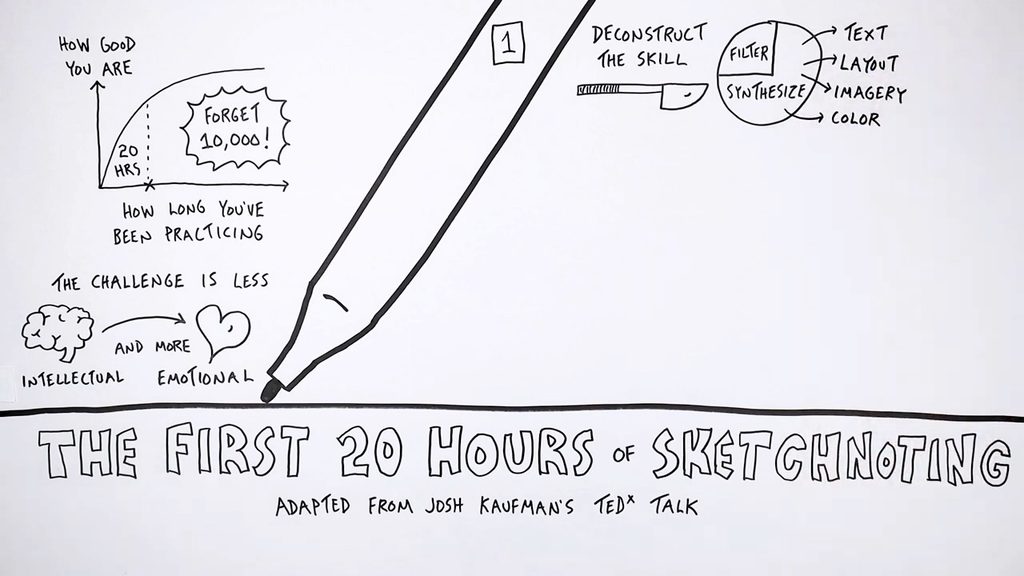
The other three quarters of the pie is spent synthesizing the ideas that make it through your filter. I tend to break that synthesis piece down into four elements:
- Text — both the decision about which words to include in your sketchnote and the use of a couple of different fonts.
- Layout — how you organize ideas on the page.
- Imagery — incorporating sketched visuals, sometimes simple icons, sometimes something a little more like a scene.
- Color — bringing in a few different colors to add contrast or set the tone. (I like sticking with black and white for simplicity.)
That’s how I break down the pie of sketchnoting.
Step 2: Learn enough to self-correct
Picture the ideal sketchnoting path. There are a couple of ways you might start to steer away from it.
One way is by trying to cram too many ideas into any individual sketchnote, in a way that creates clutter. You can self-correct by creating a stronger filter (be more picky about the ideas you choose to capture) and on the page itself, allow for more white space. White space is the breathing room that makes it easier to navigate from one idea to the next.
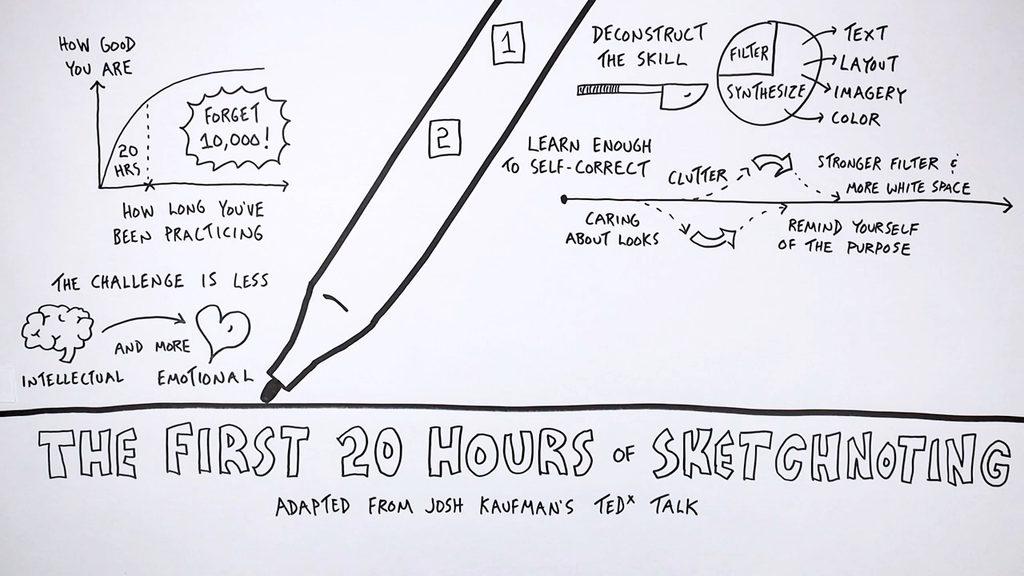
Another way you might veer off the path is by caring too much about looks, worrying about the artistic quality of your sketchnotes instead of focusing on how they’re helping you understand or communicate an idea. To course-correct, simply remind yourself of the purpose of the particular notes you’re taking. It’s probably not to create a pretty picture to hang on the wall for others to admire. It’s going to be about learning something new or working through a problem. Focusing on that purpose, and the degree to which you’re achieving it, rather than on how the thing looks, is going to make your entire sketchnoting experience a whole lot better.
Step 3: Remove the barriers to practice
One of the most helpful things you can do is have both your sketchnoting materials and your source materials at the ready and easily accessible. Keep your sketchbook and pen close by, and start keeping a list of podcast episodes, books, articles, or videos you’d like to sketchnote.
That way, when time opens up to chip away at these 20 hours, you have something to work with. You don’t waste 10 or 20 minutes just finding something to sketchnote. Instead you can hop right into some meaningful practice and skill building.
Step 4: Practice for 20 hours
No surprise here. One way to break it down is to practice 45 minutes a day over the course of a month. That’s a great setup for creating one sketchnote per day.
With each sketchnote you create, do a bit of experimentation. Play around with the four components that make up the synthesizing process:
- Text — try out a few different fonts.
- Layout — give different structures a try. Sometimes go with a mind map, other times try to create a scene that anchors all your ideas. Even something as simple as a column-by-column approach can work really well.
- Imagery — start simple, relying on basic icons, then start incorporating simple stick figures, or maybe a visual metaphor that anchors your entire page.
- Color — maybe start with black and white, then try two colors (drawing images in one, writing words in the other), then maybe three, adding a third for the helper pieces like arrows and dividers.
You can even experiment with how you filter and synthesize. I sometimes find it helpful to complete the filtering process before I move to synthesis. With podcasts, for example, I’ll take bullet-point notes while I’m listening, and then after I’ve heard the full episode, I go back and think about how those ideas fit together and how I might capture them on the page in a cohesive way. Then the next day, find another podcast and do these things in real time: listening, filtering, and synthesizing in a continuous cycle as you take notes while the episode plays or the book unfolds.
Through that experimentation with this set of skills, keep an eye out for the two things in particular that will pull you away from the ideal path: cramming in too much, and caring too much about looks. That’s what will help you make the most of your first 20 hours spent sketchnoting.
Where this can take you
The goal is to get to a place where you’re proficient enough to weave these skills into your professional or personal life in a way that has a positive impact. That’s the goal I have for my own sketchnoting skills, and it’s the goal I have in mind for you: to get you past the emotional barriers that are likely around drawing, so that you have the confidence to sketch out ideas, because of the way these visual representations help you think and work through complex ideas.
If that sounds intriguing and you’d like some support developing your filtering and synthesizing skills, learning about the different materials you might use, plus how to use them, then check out our library of courses that will get you up and running with visual thinking.

In the meantime, no matter what skill you’re developing: forget that 10,000-hour rule. Focus on the first 20, and use these ideas from Josh Kaufman to help you make the most of them.
I hope you’ve enjoyed this breakdown of the first 20 hours of sketchnoting, and I look forward to sharing more ideas with you next time.
Cheers,
-Doug