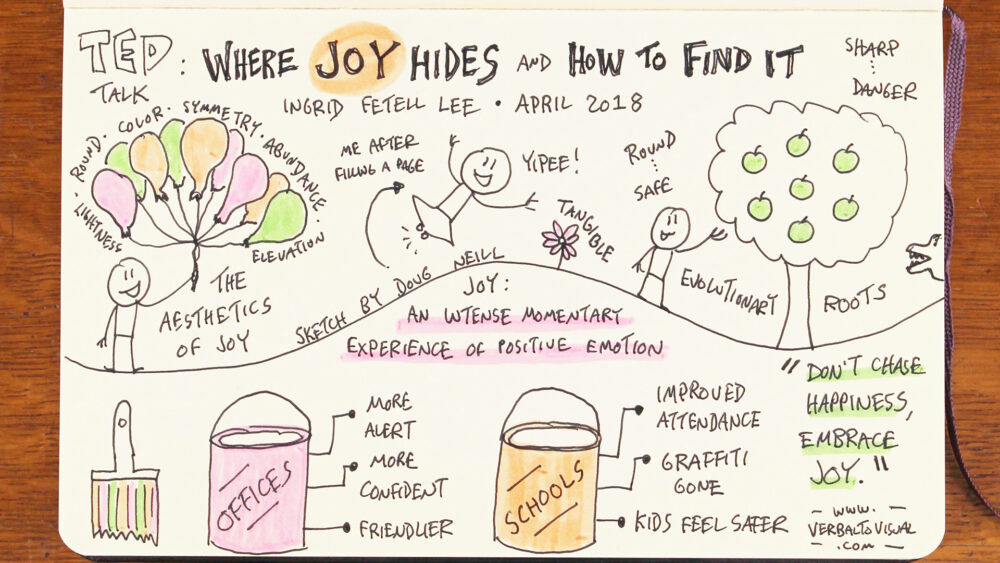
In the video above and article below, I’d like to share my visual notes of Ingrid Fetell Lee’s TED talk titled Where Joy Hides and How to Find It.
After being told that her work gives others a feeling of joy, she decided to investigate why that was. What is it about certain things that we experience in the physical world that bring us joy?
After collecting a large list of things that bring us joy — cherry blossoms, bubbles, swimming pools, treehouses, balloons, googly eyes, ice cream cones with sprinkles, rainbows, and fireworks — she saw enough commonalities to identify what she calls the aesthetics of joy: things that are round, have pops of color, symmetrical shapes, a sense of abundance, and a feeling of lightness or elevation.
Where happiness describes how good we feel over time, joy is experienced in the moment. It’s defined as an intense, momentary experience of positive emotion, often exhibited by the desire to jump up. It’s a much more tangible experience compared to happiness, and it likely has evolutionary roots — an attraction to color and abundance that supported our survival as a species.
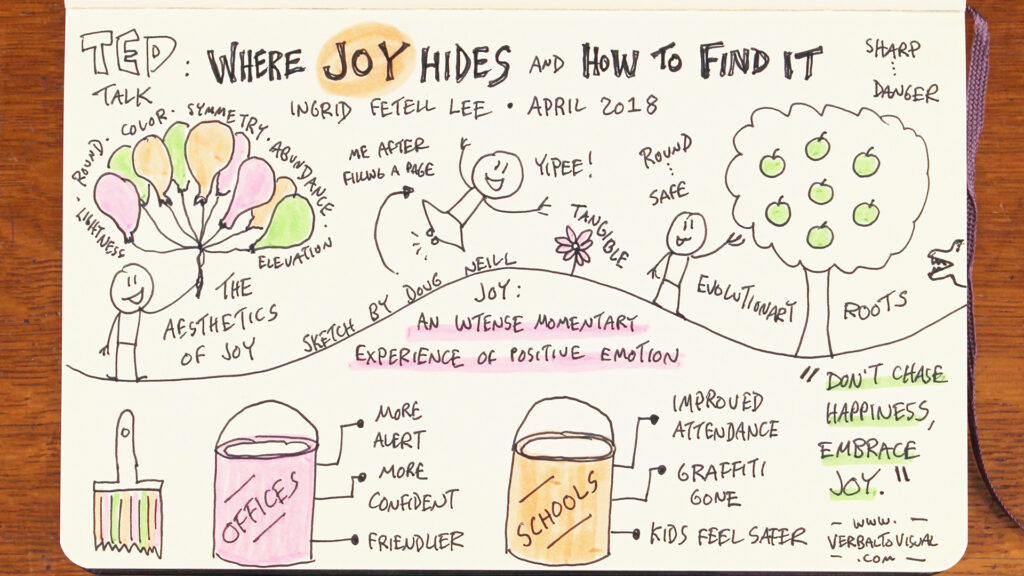
Studies have shown that round shapes make us feel safer and more at ease, whereas angular shapes and objects make us feel more cautious, aware of potential threats. Other studies have shown the benefits that come from bringing color into spaces that often lack it, like the office. Workers in colorful offices reported feeling more alert, more confident, and even friendlier compared to those in drab office spaces. After adding more color to the inside and outside of a school environment, they saw improved attendance, no more graffiti, and kids feeling safer.
So the encouragement here: don’t chase happiness — instead, embrace joy. Be open to it when you experience it in your surroundings, and maybe even take a note from the aesthetics of joy to create it within your own spaces. As Fetell Lee puts it, those moments of joy add up to more than the sum of their parts.
For more of the details, do go watch the talk yourself.
For my part, I tend to feel a sense of joy after I’ve filled the page with sketchnotes like those you see above.
If you too would like to learn how to take visual notes (which might bring a bit more joy into your learning process) then come join us inside of Verbal to Visual where you’ll find a library of complete-at-your-own-pace courses plus weekly live workshops.
Cheers,
-Doug