How do we tell the story of America?
That’s the question Yoni Applebaum explored in an article in The Atlantic in July of 2026, as our country celebrated its 250th birthday. As it turns out, the story we tell has shifted quite a bit over the years.
The Consensus School: A Nation of Ideals
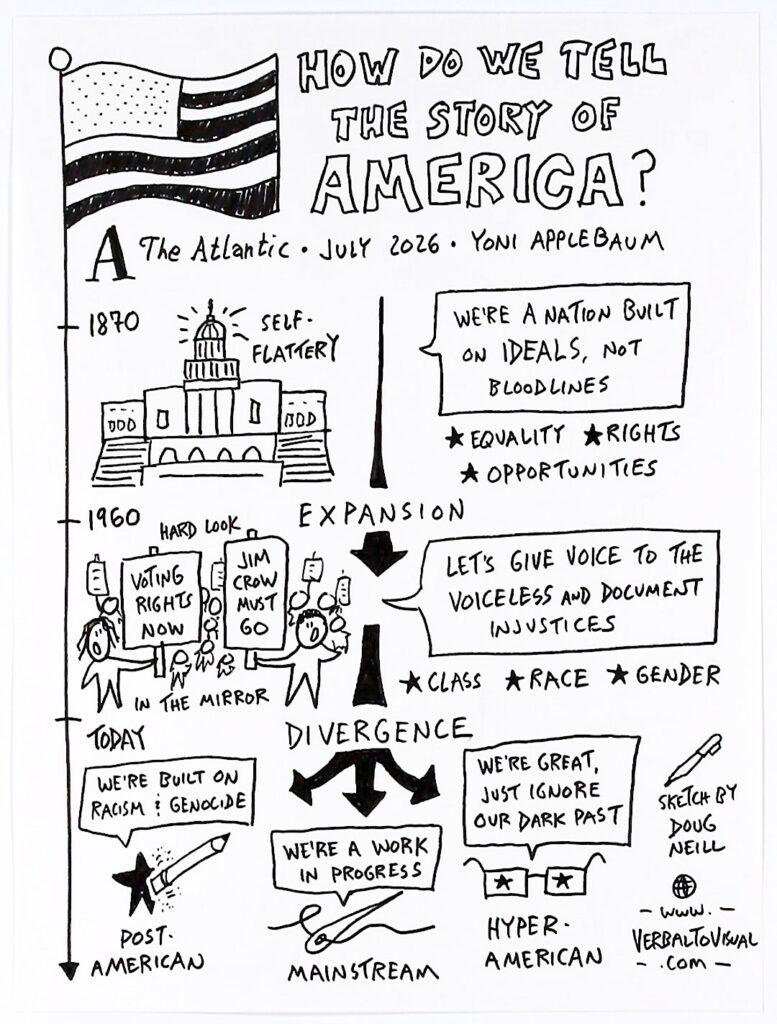
From the middle of the 19th century to the middle of the 20th, historians told a fairly consistent story: we are a nation built on ideals, not bloodlines, and that’s what makes us special. We are a nation that prioritizes equality, rights, and opportunities.
This “consensus school” of thought engaged in a decent amount of self-flattery.
The Hard Look in the Mirror
Then, in the 1960s, we started to see an expansion of that story. As women and people of color joined universities and became historians themselves, they began telling new stories. They gave voice to those who had been voiceless, and they documented the injustices that the self-flattery of the consensus school had glossed over. These histories took a closer look at the role of class, race, and gender in America’s past.
Those important stories got told, but there was little effort to assemble the pieces into a comprehensible narrative. We might call this the hard look in the mirror stage of telling America’s story.
The Challenge of Divergence
What we face today, according to historian Johann Neem, is perhaps a bigger challenge: a challenge of divergence, with historians breaking into three broad groups telling three competing versions of the American story.
The first is what Neem calls the mainstream approach, grounded in the notion that America is a work in progress. It represents a blend of the self-flattery of the early historians and the hard-look-in-the-mirror acknowledgments of how we’ve fallen short of our ideals.
The second story lives on the political left, what Neem calls the post-American approach. It takes the expansion stage even further, centering our story on the fact that we were built on racism and genocide.
Then, on the right, we’ve got the polar opposite: the hyper-American story. It says we’re great, so just ignore our dark past. Go ahead and take down that display about George Washington’s slaves. And while you’re at it, remove that reference in the Grand Canyon to how federal officials pushed tribes off their land to establish the park in the first place.
As Applebaum writes:
Deleting accounts of the past not because they are false, but because they are true, betrays a curious lack of confidence.
And it’s a lack of confidence that isn’t warranted. As we’ve seen with more truthful reckonings of our past, from Jill Lepore’s book These Truths to Heather Cox Richardson’s Substack, a large majority of Americans prefer history that challenges what they know over accounts that reinforce it.
Those works, along with Nikole Hannah-Jones’ The 1619 Project, live perhaps at the intersection of the mainstream and the post-American approach. No more self-flattery, but let’s not burn the whole thing down. Parts of it, maybe, but not all of it.
Toward a Coherent Story
What’s important is that we keep telling the American story, the whole American story, and that we keep searching for a coherent version of it. Because, as Applebaum writes:
Without a coherent national story, we will fail to be a coherent nation.
Want to learn how to take visual notes like the ones you see here? Check out these resources.