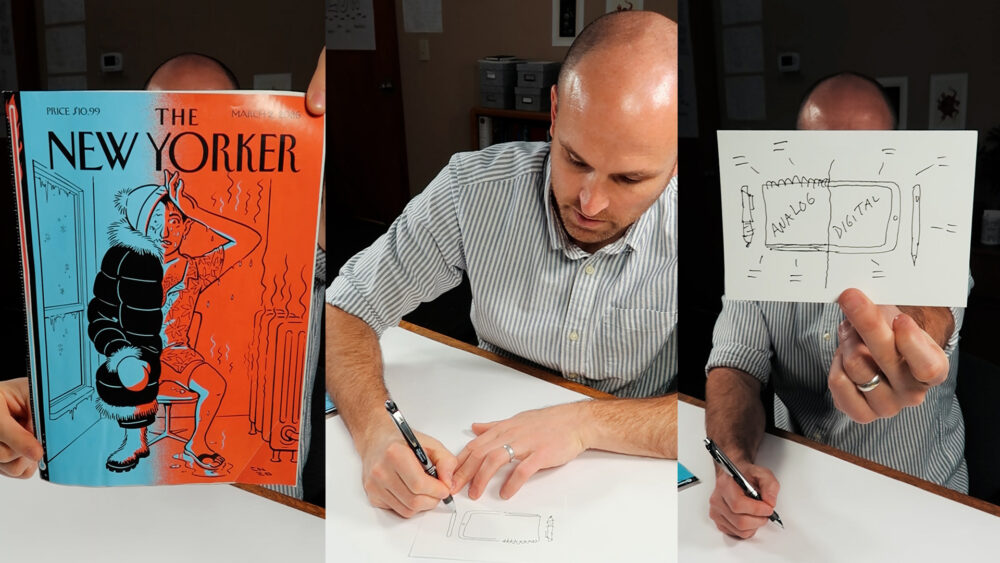
Here’s the cover of the March 2nd, 2026 New Yorker. I think it’s a cool example of a visual thinking technique that you might be able to apply to your own work, even if it’s less illustrative than this is.
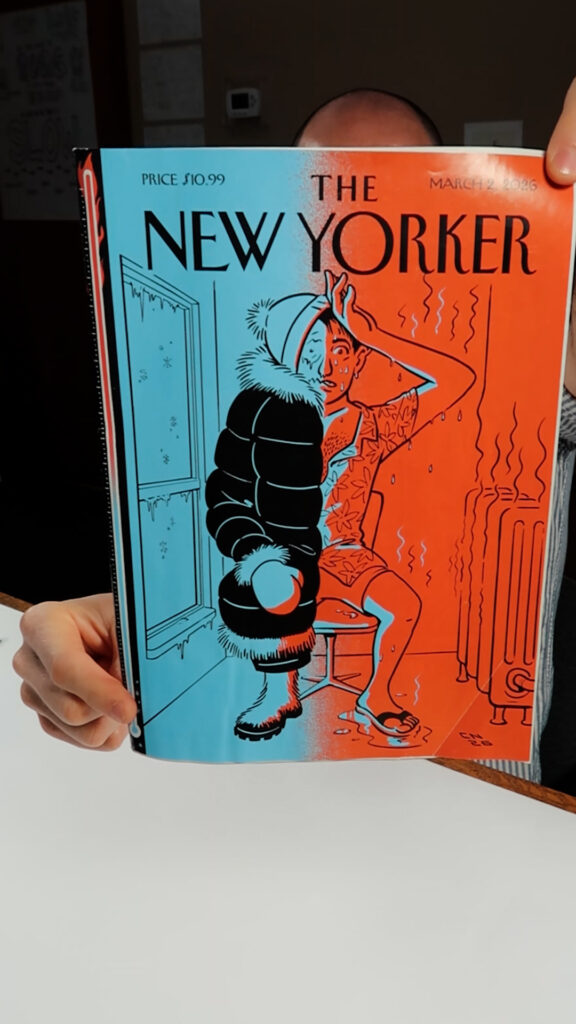
The term that comes to mind for this is bilateral asymmetry. You’ve got this person sitting in an apartment, either freezing with a parka on or dripping sweat in shorts and a t-shirt.
This could be a useful style of visual when there’s a certain contrast you want to make between two ends of a given spectrum — hot versus cold, difficult versus easy, digital versus analog. If the topic you’re dealing with has one of those contrasts, a “this or that” that’s at the center of the topic, you might try incorporating bilateral asymmetry into your visual depiction of it.
For example, if I were to create a sketch detailing my approach with digital versus analog tools, I might create a sketch where the left side is a physical notebook with a pen to the side of it, but then that notebook morphs into a tablet, like an iPad with an Apple Pencil. We could put a line down the middle to make that division clear.
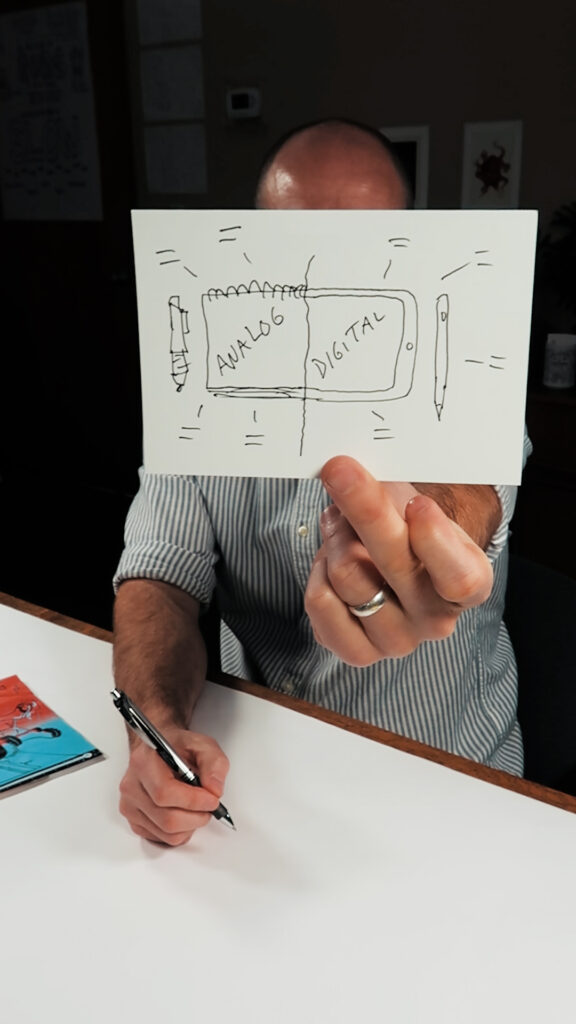
Then if I were capturing my reflections on when I use analog tools versus when I use digital ones in my visual thinking process, I could capture those reflections around an image that looks like that.
So if there is a binary “this or that” component to the topic you’re thinking about, learning about, or communicating to others, try incorporating some bilateral asymmetry into your visual depiction of that topic to see if it makes for a useful container.
If you’d like to incorporate visual thinking into your learning, problem-solving, and communication, check out our library of courses.
Happy sketching,
-Doug