Why are U.S. politics so divisive? That’s the question Crash Course recently asked and answered in a new series called Big Questions on U.S. Government, hosted by Kousha Navidar. Here I’d like to share a visual summary of that episode.
It Wasn’t Always This Way
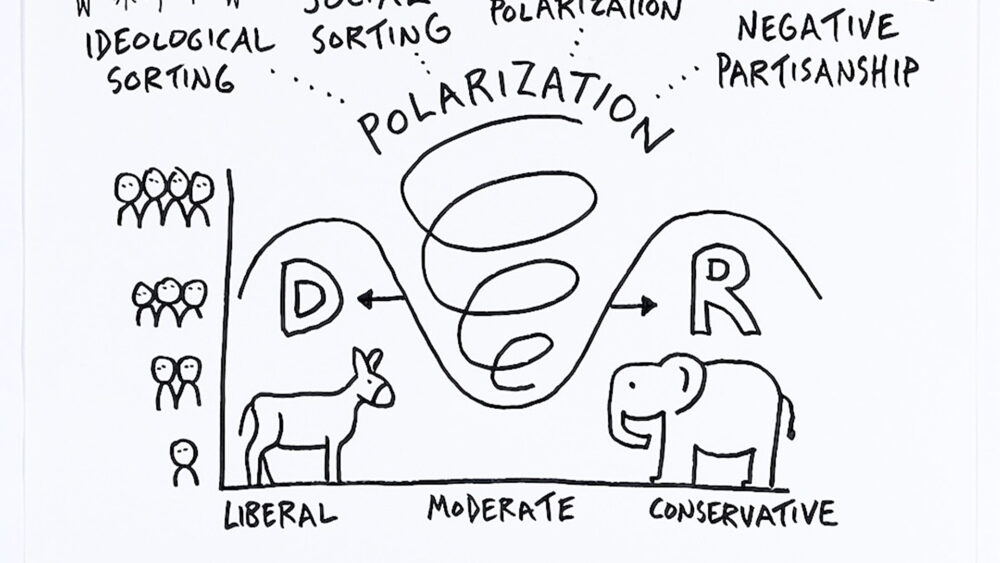
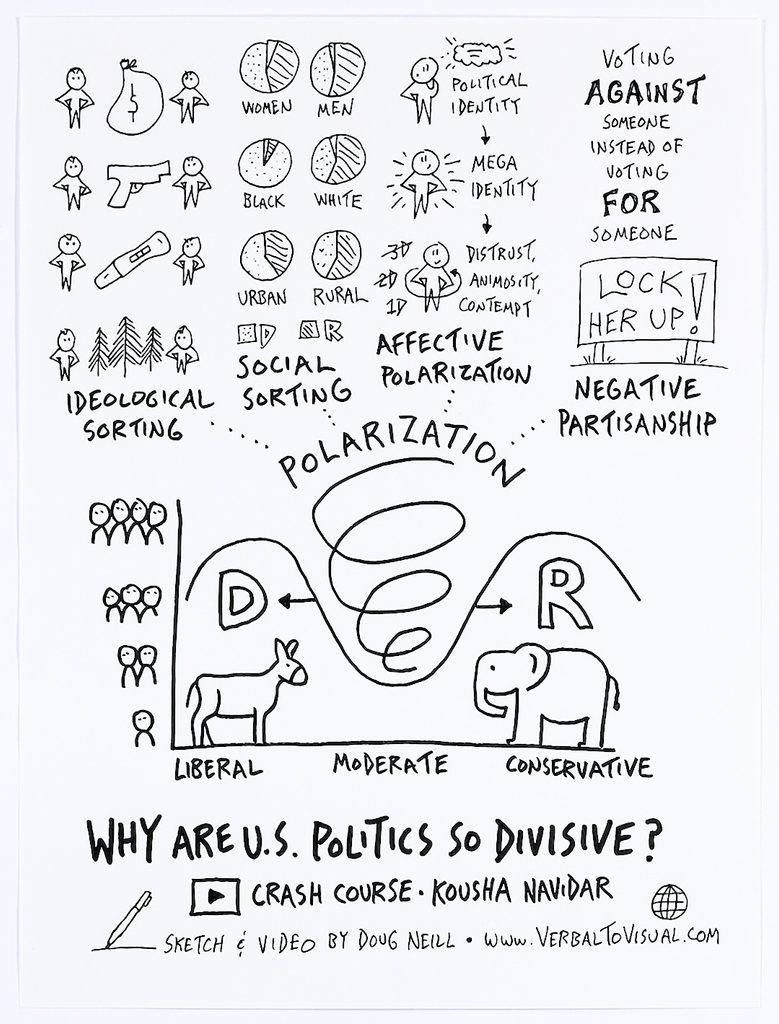
Let’s start with a graph that represents our current polarized political culture.
It didn’t used to be the case that all Democrats were liberal and all Republicans were conservative. In fact, in the post–Civil War Reconstruction era, it was liberal Republicans who led the charge to expand voting and civil rights for Black Americans, and it was conservative Southern Democrats who implemented Jim Crow laws.
What we’ve seen in recent decades, though, is a self-perpetuating cycle of polarization that’s causing an ever-widening gap between liberals and conservatives, Democrats and Republicans. So let’s explore some of the factors that have contributed to that polarization.
Ideological Sorting
You’ve likely noticed that it’s easier to guess someone’s party based on their stance on a single issue, like what they think about taxes, gun control, abortion, or the environment.
That represents a more stringent ideological sorting: the process by which people align their party identity with a liberal or conservative ideology.
Social Sorting
There’s also sorting happening on a social level:
- Women lean slightly Democrat, and men lean slightly Republican.
- Black Americans lean heavily Democrat, and white Americans lean Republican.
- Urban Americans lean Democrat, while rural Americans lean Republican.
That social sorting is the process by which certain identities have become increasingly tied to one party over another.
From Political Identity to Mega Identity
Together, ideological sorting and social sorting have supported a shift from an individual having a political identity to having a more all-encompassing mega identity, where your political affiliation is the one identity that rules all others.
That shift impacts how you see and interact with people who identify the other way. Instead of seeing others as three-dimensional human beings, our perspective reduces them to two dimensions, if not one.
Affective Polarization and Negative Partisanship
Taken to its extreme, this polarization leads to distrust, animosity, and contempt, which goes by the term affective polarization.
That view of the other side often results in us voting against someone instead of voting for someone, with less and less attention paid to a given candidate’s specific platform. This negative partisanship has become an increasingly powerful force in both national and local politics.
Not the End of the Story
Even though all of this has made it harder and harder to find common ground, Navidar reminds us that we have weathered challenges before, and that this is not the end of the story.
It’s a story Crash Course will continue to explore throughout this series, and one I plan to keep sketching out. I enjoy Crash Course as a source, and I’m looking forward to seeing where they take this series and sharing what I learn with you. So stay tuned!
Want to learn how to take visual notes like the ones you see here? Check out these resources.