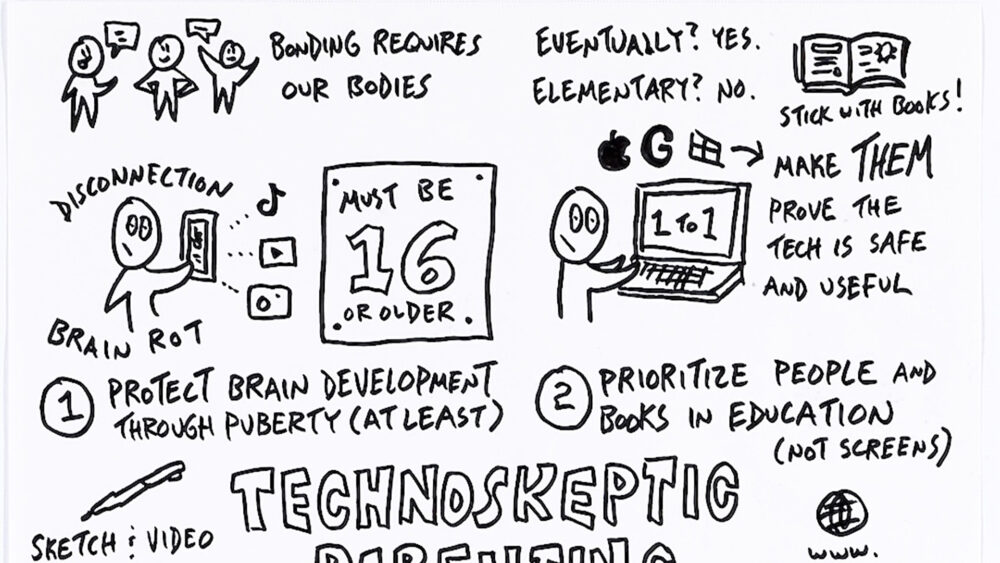
If you’re concerned about the role of technology in your kid’s life, Jonathan Haidt offers three strategies in his 2026 TED talk. Here’s a visual summary and a quick recap.
1. Protect brain development through puberty
Protect brain development at least through puberty, especially when it comes to social media. A world where dopamine is just one swipe away can lead not only to disconnection among peers, but also to “brain rot” during the crucial years when adolescent neural networks are still forming.
The best move is to do what Australia did and raise the minimum age for opening a social media account to 16.
Here’s the thing: bonding requires our bodies. As an ultra-social species, our brains should be formed by interactions in the real world, not by social media algorithms. So it’s no surprise that studies have shown that when you cut out social media, anxiety and depression go down.
2. Prioritize people and books in education, not screens
You’re probably familiar with the concept of a one-to-one classroom, in which every student has their own device. But no one took the time to study whether that setup actually improves learning outcomes. In fact, the push for one-to-one classrooms coincided with a steady decline in national test scores.
Instead of going along with tech companies’ desire to get kids hooked into their ecosystems, we should make those companies prove that their technology is safe and actually useful.
But shouldn’t kids learn how to use these tools? Yes.
Do they need them in elementary school? No.
It’s much better to stick with books and with face-to-face interaction with teachers and peers.
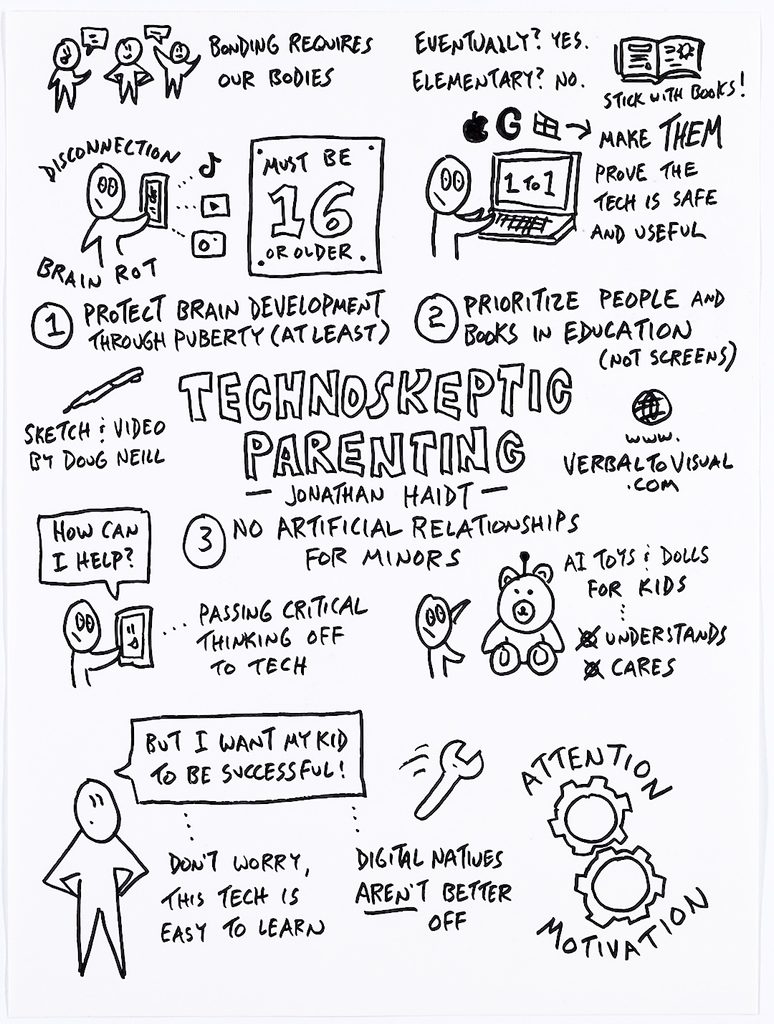
3. No artificial relationships for minors
Just a few years ago, this rule would have sounded both absurd and obvious. Now, with the arrival of AI chatbots, it’s easy for kids and adults alike to hand off their critical thinking to technology.
Even more disturbing, this technology is now being built into teddy bears, dolls, and other toys for kids. These toys give the impression that they understand the child and care about them, which of course they don’t.
“But I want my kid to be successful”
As a parent, you might look at some of these technologies and think, “But I want my kid to be successful.” You don’t need to worry, for two reasons:
- This tech is easy to learn. Kids can pick it up if and when it becomes useful and appropriate.
- Digital natives aren’t better off. These technologies throw a wrench into our attention and motivation systems, hijacking them to our detriment.
The takeaway
For more, go watch the full talk. In the meantime, use these strategies to maintain a healthy skepticism toward the technologies that are encroaching on kids’ and adults’ ability to live meaningful, connected lives.
Want to learn how to take visual notes like the ones you see here? Check out these resources.