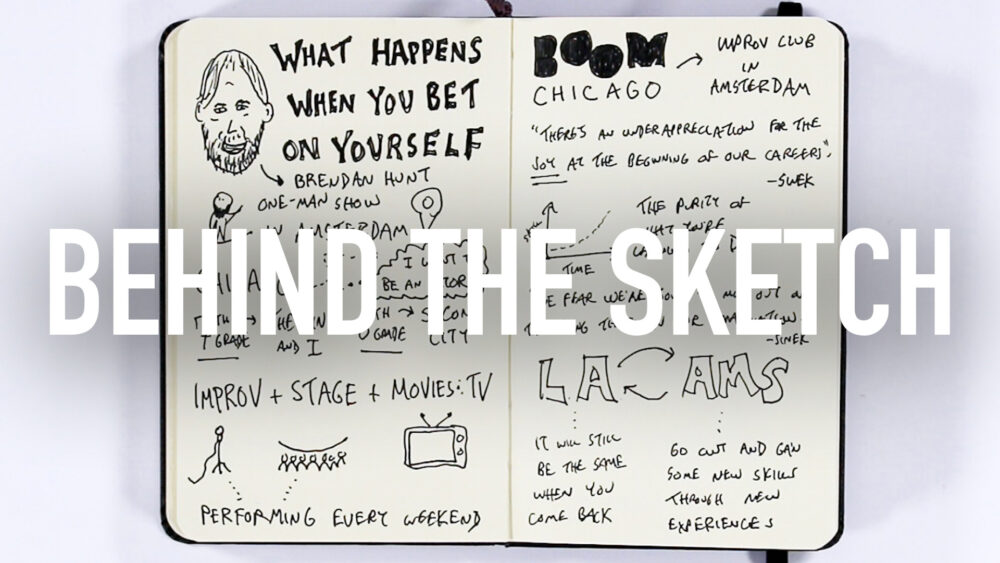
In this video I returned to a format I hadn’t reached for in a while: a small Moleskine notebook and a one-and-done approach to sketchnoting. No polished single-page summaries here. Just active listening, capturing ideas as they came, and resisting the urge to redo anything.
The source was an episode of Simon Sinek’s show A Bit of Optimism, featuring Brendan Hunt, better known as Coach Beard from Ted Lasso. Even though I do some form of visual note-taking nearly every day, this particular size constraint had me feeling a little rusty. But that’s kind of the point. One-and-done notes aren’t about making pretty pictures; they’re about engaging more deeply with what you’re hearing. Here’s how the five pages came together.
Page 1: Getting Warmed Up
The episode opens with a bit of Hunt’s background: how a seventh-grade role in the school play The King and I and an eighth-grade trip to Second City sparked his interest in performing. He carried that through college into improv comedy and stage work, with a lasting interest in movies and TV alongside it.
This first page was really me reminding myself what this format feels like. In retrospect, I would have placed the “I want to be an actor” thought bubble below the seventh- and eighth-grade highlights, rather than squeezing it into the nearest chunk of white space.
Page 2: Amsterdam, Joy, and FOMO
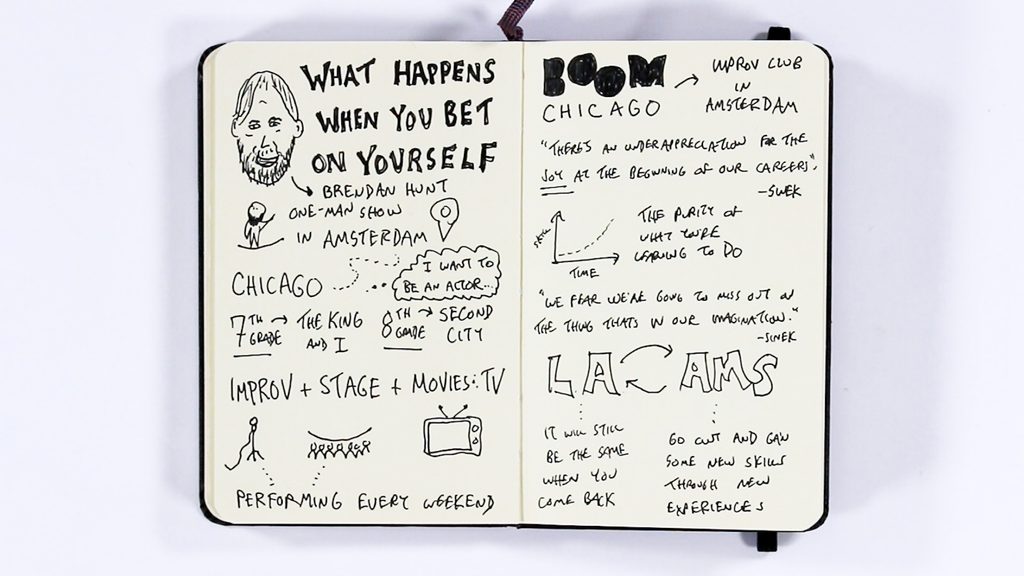
Here I settled into more of a row-by-row flow, which really matters on a page this small. The conversation covered Hunt’s time in Amsterdam at the improv club Boom Chicago, the logo of which I found with a quick Google image search.
Sienk made a point I enjoyed: an appreciation for the joy at the beginning of a career. As he said it, he made an upward motion with his arm, which nudged me to plot it as a simple skill-versus-time graph, capturing that purity that comes when you’re first learning to do a thing. There was also a nice thread about FOMO, the idea that we fear missing out on something that only exists in our imagination and might not even be real, and that the things you step away from will most likely still be there when you return. Since Hunt’s story bounces between Amsterdam and the U.S. (Chicago and LA), I drew that back-and-forth as a cycle.
It’s a text-heavy page, but I like how the Boom Chicago logo anchors it, and how the eye lands on the skill-versus-time graph and the LA–Amsterdam cycle. If I did another draft, I’d try tucking “FOMO” between those arrows, circled with an X through it. But since these are one and done, I left it as is and kept moving.
Page 3: The Origins of Ted Lasso
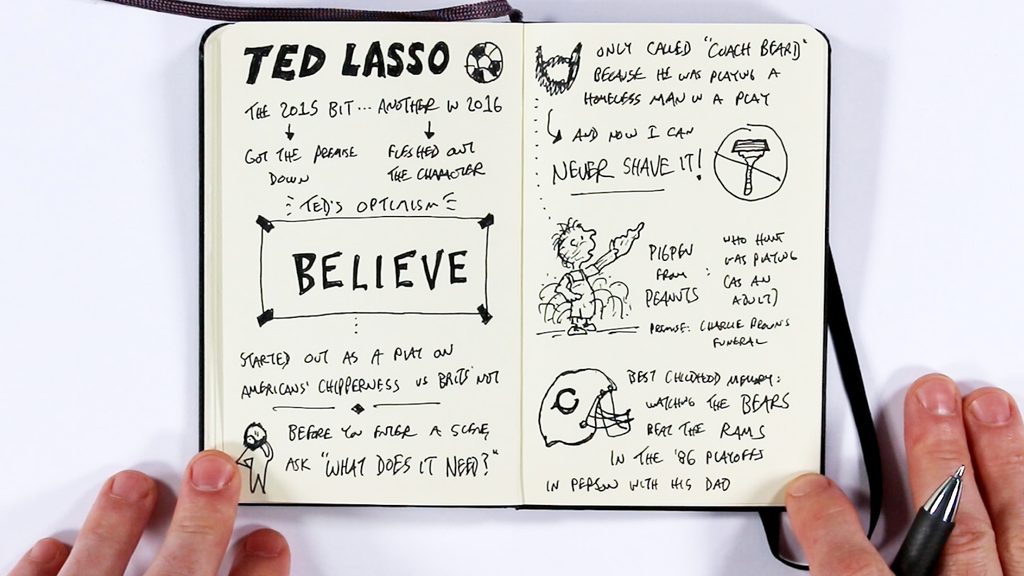
Next the conversation turned to Ted Lasso, the project that carried Hunt to fame beyond his theater and improv circles. It began as a 2015 NBC commercial introducing the character of an American football coach sent to England to coach the original football in the Premier League. That first bit nailed the premise; a 2016 follow-up commercial fleshed the character out further, and in the years after they realized there was a real story worth building into a full show.
They dug into Ted’s optimism and where it came from, something that wasn’t in the original 2015 bit but became central to the show, starting as a play on American optimism versus the Brits’ lack thereof. It was easy to pull in the “Believe” sign here, since it plays such an important role in the show and came up in the conversation.
That led into Coach Beard’s role as the supporting character, there to give Ted whatever he needs, which Hunt tied to a core acting approach that doubles as a good approach to life: before you enter a scene, ask what does it need? What does this scene (or this room, this moment with these people) need from me? I drew a little star person in one of my go-to contemplative poses, and had fun going back in to add the beard.
Page 4: The Beard, Pigpen, and a Bears Game
The beard itself became a topic. Hunt’s character had no name at all in the original bit, and the only reason he even had a beard during that shoot was that he was playing a homeless man in a one-man play he’d written. Now that it’s iconic, he says he can never shave it. That play had an interesting premise: he played a grown-up Pigpen from Peanuts, with the characters reunited for Charlie Brown’s funeral. When asked for a positive childhood memory, Brendan shared getting to watch the Chicago Bears beat the Rams in the ’86 playoffs in person with his dad.
This was probably the best balance of imagery and text so far. By now I’d settled into the row-by-row rhythm and was tuning in to identify an image (often before writing anything) moving from the beard to the razor to Pigpen to the Chicago Bears.
Page 5: Craft over Fame
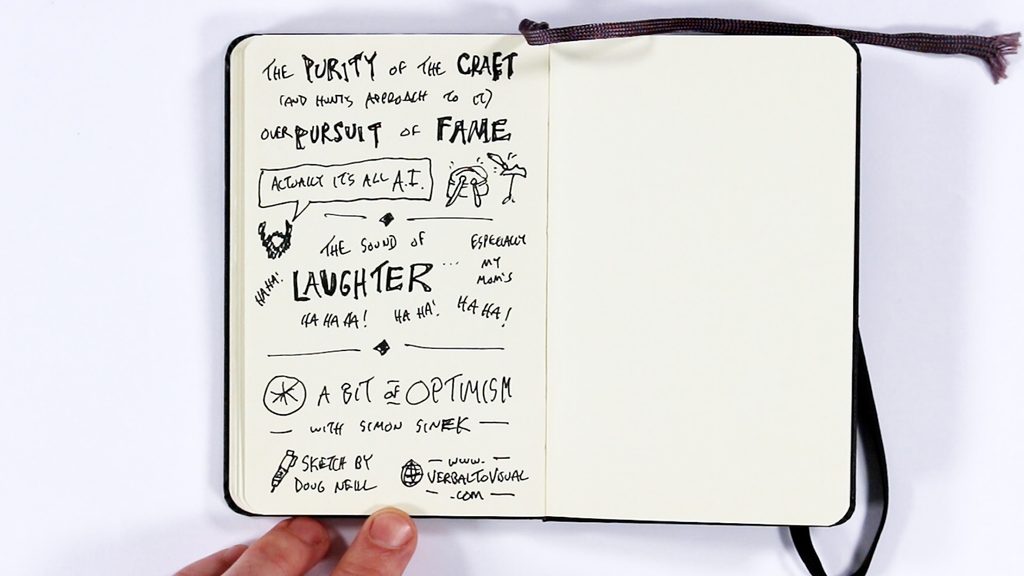
On the final page my handwriting got noticeably sloppier. I tried bolding the keywords in “the pursuit of craft over the pursuit of fame,” and the bolding didn’t go well, which was a good reminder that this kind of lettering takes space. When you want to emphasize a word, you draw the letters large first, but to come back and bold them cleanly you have to give them room to begin with. I crowded mine, and it showed.
After that thread on the purity of craft, Hunt tossed off a joke, “Actually, it’s all AI!”, and I added a little drum-and-cymbal to land the ba-dum-ching. They also touched on the simple sound of laughter as a motivating force in his work and life, going all the way back to trying to make his mom laugh as a kid. I closed the page with some classic dividers (a bold diamond in the center with lines on either side), sketched the A Bit of Optimism logo to credit the source, and added my signature and website.
Looking Back
Am I rusty at this particular format? Yes. Some sections aren’t as clear or as visually interesting as I’d like. But I have to remind myself (and you) that one-and-done visual notes aren’t about polished pictures. They’re about engaging more deeply with the ideas you’re taking in. Even just filtering and capturing a few short phrases does you good, and adding simple imagery and diagrams along the way gives you both visual and verbal pathways back to those ideas.
If this got you excited to take your own visual notes but you’re not sure where to start, then check out our library of courses that will get you up and running in no time.

Those courses will help you build your skills from the ground up and then apply them to work that you care about.
Cheers,
-Doug