Civil service has got a bad rap lately. So much so that the President deemed it necessary to create the Department of Government Efficiency, which took on a campaign that led to the firing and forced exit of 300,000 workers who had signed up to make their country (and the world) a better place.
Earlier this year, The Atlantic published an article featuring 50 of those individuals who had been forced out of their work. Here I’d like to share the brief story of six of those people. Because it’s easy to lament the inefficiencies of government when speaking in the abstract. It gets harder when you look at specific people and the work that they do (or did).
I want to acknowledge that I’m not that great at drawing people. I’m not a professional illustrator. I’m a visual note-taker. But I did my best.
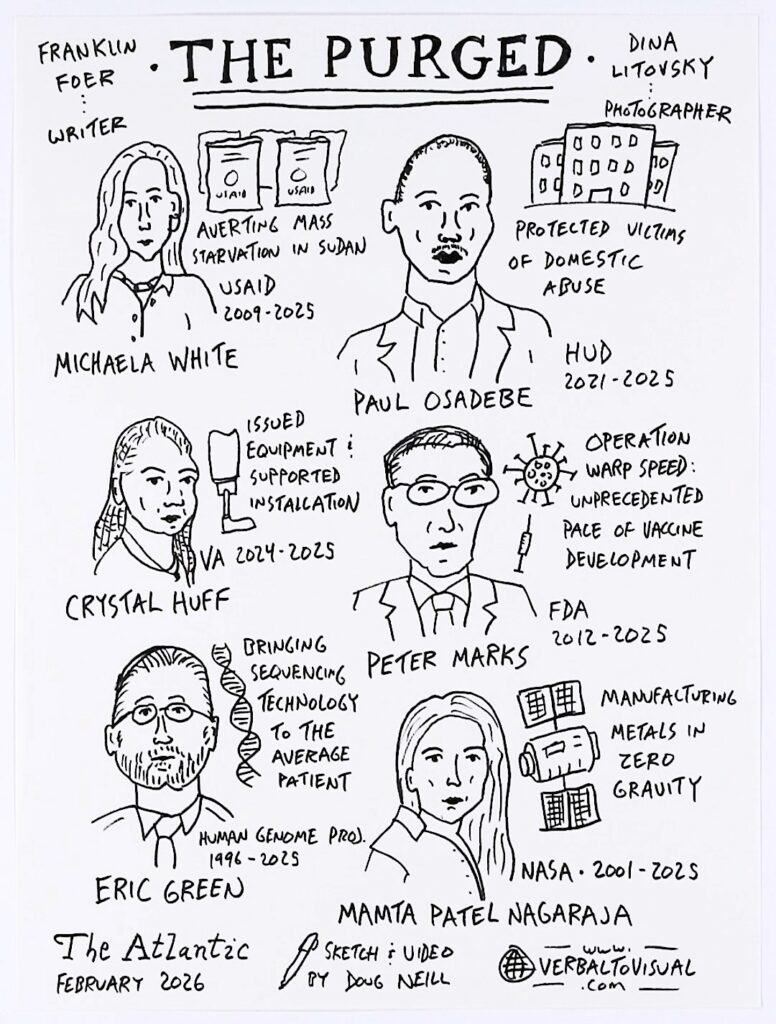
Michaela White was the senior humanitarian advisor for the United States Agency for International Development. She facilitated aid work in Haiti after the devastating earthquake in 2010. She was in the process of averting mass starvation in Sudan when Trump signed an executive order freezing USAID’s programs.
Paul Osadebe was an attorney for the Department of Housing and Urban Development. He wrote regulations that made it easier to bring housing discrimination suits, and he prosecuted cases related to the protection of victims of domestic abuse.
Crystal Huff was a prosthetic clerk at the Department of Veterans Affairs, where she issued equipment and supported installation not just of artificial limbs, but also wheelchair ramps and other supportive equipment.
Peter Marks was the director of the Center for Biologics Evaluation and Research within the Food and Drug Administration, and was a driving force behind Operation Warp Speed, leading the FDA’s review of COVID-19 vaccines at an unprecedented pace.
Eric Green was the director of the National Human Genome Research Institute within the National Institutes of Health. In his work on the Human Genome Project, he was striving to make sequencing technology cheap enough for the average patient, enabling diagnoses of rare diseases.
Mamta Patel Nagaraja was the associate chief scientist for exploration and applied research at NASA. She helped design a rescue vehicle for the International Space Station, guided experiments that exploited the manufacturing possibilities in the weightlessness of space, and worked with a team that was creating carbon fiber in its strongest form.
As we near the United States’ 250th birthday, I think it’s worth appreciating the people who work for the government and are actively trying to improve the lives of those who live here and around the world. These are just six of the 50 individuals featured in that Atlantic article from February of this year, which is itself a tiny fraction of the 300,000 that were purged in Trump’s first year back in office.
As Franklin Foer writes, “Capturing the magnitude of the destruction is an almost impossible task. Statistics can convey the scale, but only individual stories reveal what has actually vanished: the knowledge and skill that have been recklessly discarded.”
Want to learn how to take visual notes like the ones you see here? Check out these resources.