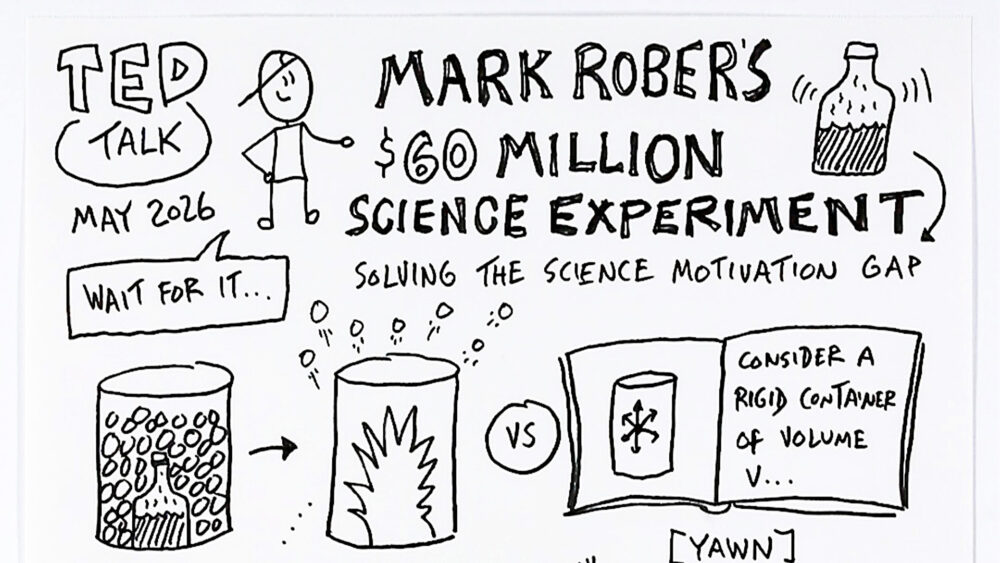
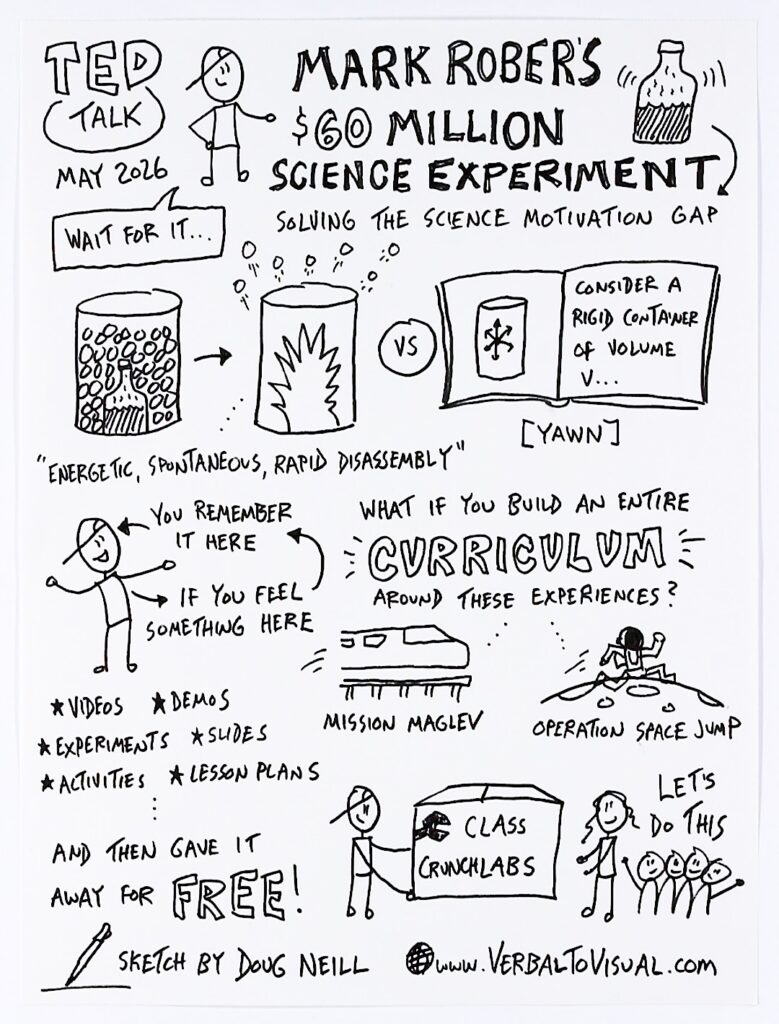
In his new TED Talk, Mark Rober outlines the $60 million science experiment he is conducting. Here I’d like to share my visual notes of that talk.
A Visceral Opening
He starts with a bottle half filled with liquid nitrogen, which boils at room temperature. Once you screw the lid on tight, the pressure builds as that liquid turns into a gas.
Rober’s goal is to solve the science motivation gap, using his experience as a YouTuber to create demonstrations that spark the interest and curiosity of viewers, including the live audience of this TED talk.
After closing up that bottle of liquid nitrogen, he dropped it in a trash can, dumped in a load of ping pong balls on top, then waited for the energetic, spontaneous, rapid disassembly to occur.
It blew up.
Feel It Here, Remember It Here
Rober then compared that visceral experience that the audience got to have with that of reading the typical science textbook, where you see phrases like “Consider a rigid container of volume V…”
As Rober says, if you feel something here (pointing to his chest) you remember it here (pointing to his head). Learning is best when it’s attached to a visceral experience.
And recently, Rober has been asking himself the question: what if you build an entire curriculum around those experiences?
Class CrunchLabs
That is precisely what he is doing: building a unit on electricity and magnetism starting with maglev trains, building a curriculum around gravity by replicating what it’s like to jump on the moon, and collaborating with a whole team of educators to produce not just high quality videos for the classroom, but also demos and experiments that can be conducted in class, slides for teachers and students, additional learning activities, and lesson plans that exceed science education standards.
And then: what if you give it all away for free?
That is precisely what he is doing with Class CrunchLabs. The $60 million, which comes from donors, will be funding a full science curriculum designed for third through eighth grade, with 40 total units that will be rolling out in the coming years. The first three are already available for teachers to start using.
Go Watch It
To experience a bit of that visceral reaction for yourself, go watch the TED Talk, especially if you’re an educator.
And if you’d like to explore this visual way of documenting your experiences (AKA visual note-taking), check out the curriculum I built to help you introduce visual note-taking skills to your students.
It’s called Sketchnoting in the Classroom, and it might pair well with the type of learning experience Rober is supporting.
Cheers,
-Doug