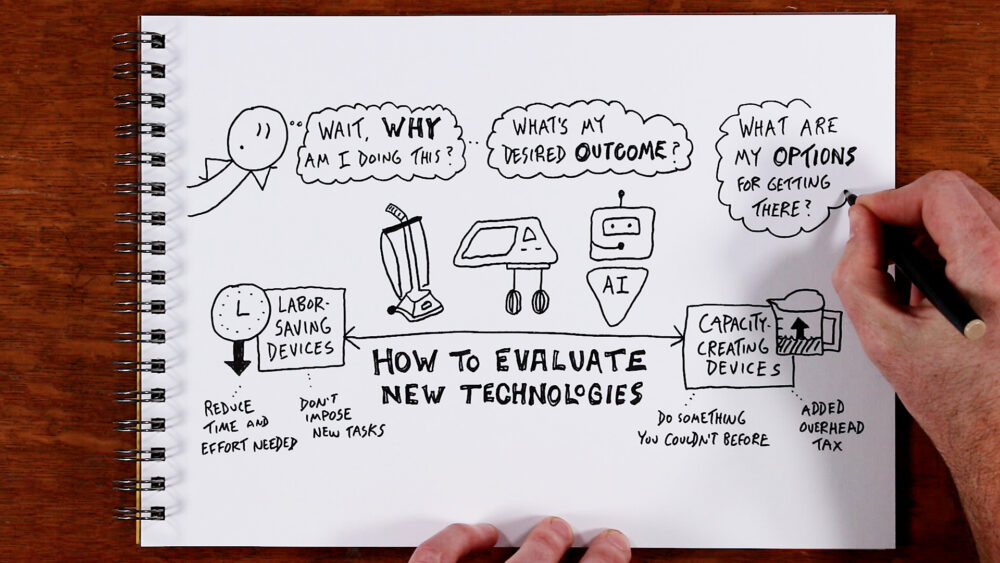
In a recent episode of her podcast What Works, host Tara McMullin encourages us to ask this question much more often: Wait, why am I doing this? Especially when it comes to the adoption of new technologies.
Labor-Saving vs Capacity-Creating
New technologies can be broken down into two categories: labor-saving devices and capacity-creating devices.
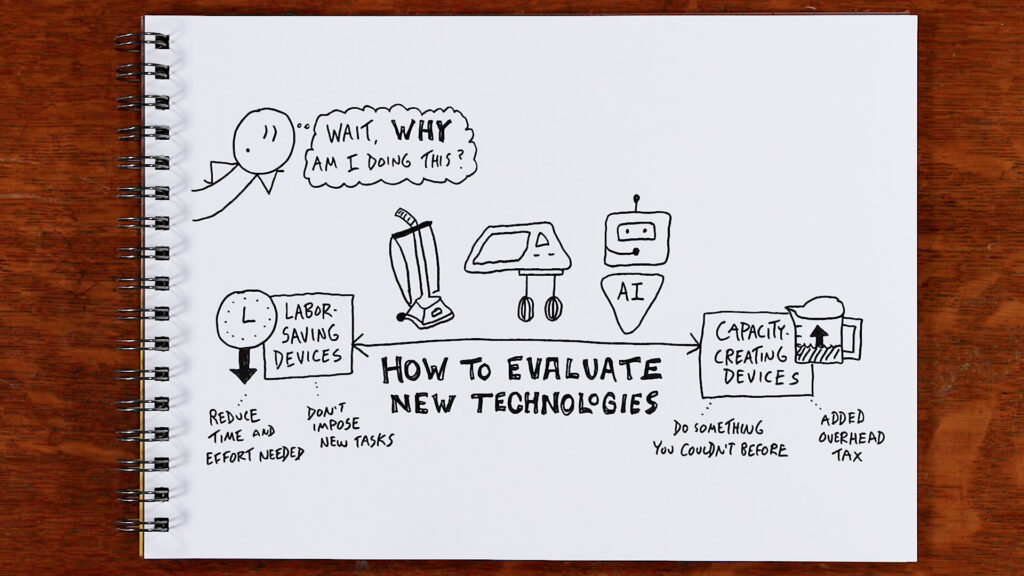
New technologies like the AI tools that you’re likely seeing everywhere rarely fall into one bucket or another, but instead live somewhere along this spectrum. Placing them along that spectrum is a useful way to evaluate whether or not a new technology is worth it for you.
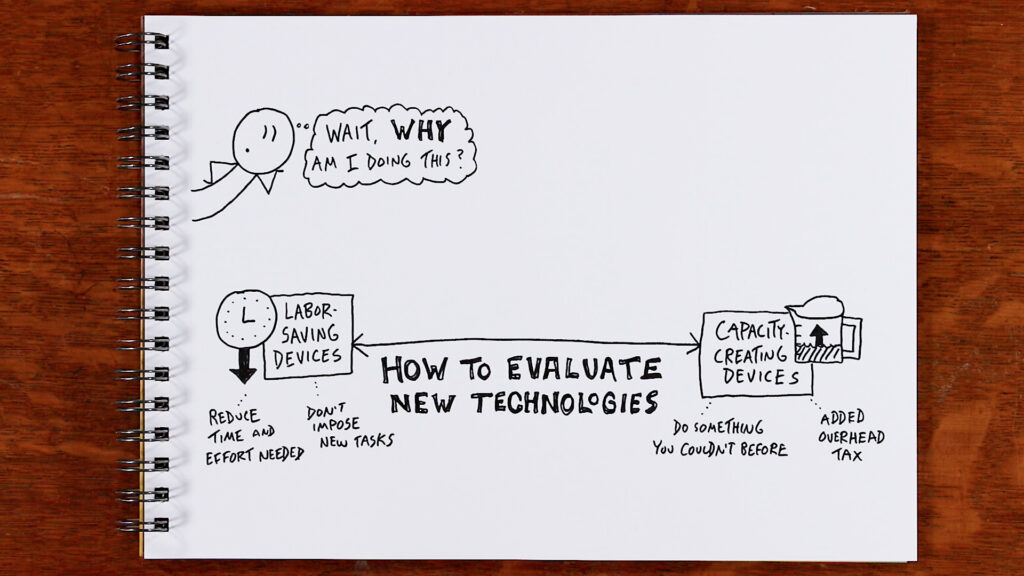
Labor-saving devices reduce the time and effort needed to complete a task without imposing new ones.
Capacity-creating devices, on the other hand, allow you to do something you couldn’t do before. With that new capacity comes what Cal Newport calls an “overhead tax” in his book Slow Productivity, with added management associated with your overall workflow. It’s yet another thing for you to manage.
The Eggbeater Effect
Before getting to the specifics of AI, McMullin references the book More Work for Mother and talks about the introduction of devices like the vacuum cleaner and the eggbeater. Those devices allowed for certain tasks to be completed faster, but they also set up the expectation that those tasks would be done more frequently, without help from others, along with expectations like, “Now that you’ve got an eggbeater, you better start making some fancier dishes!”
So with the introduction of any new individual tool, it’s worth looking at not just the singular task that tool helps you complete, but what it also means for the overall workflow of cleaning the house or making meals. Are you actually saving time and effort, or are you just adding more elements to your to-do list?
AI Tools and the Same Trap
Many folks are facing those same questions through the bombardment of AI tools that are being added to just about every piece of software you work with. Sure, your podcast or video editor might be able to automatically create clips for you, but how good are those clips? To what degree do you have to re-edit them? What amount of effort is involved in posting them?
In a lot of cases, AI tools aren’t labor-saving devices, they’re capacity-creating devices. So instead of reducing work, they’re intensifying it, adding work and stress to the potentially fewer number of humans who are expected to leverage those tools.
Ask the Deeper Questions
Instead of getting sucked into all of those capabilities, McMullin encourages us to step back and ask that question: Wait, why am I doing this?
- What’s my desired outcome with this work?
- What are my options for getting there?
- Is doing more of something (or a slightly fancier version of something) worth it, or is it just a distraction?
Just because you can do something new with one of these AI tools doesn’t mean that you should. At the same time, just because it’s a new technology doesn’t automatically mean that you shouldn’t use it.
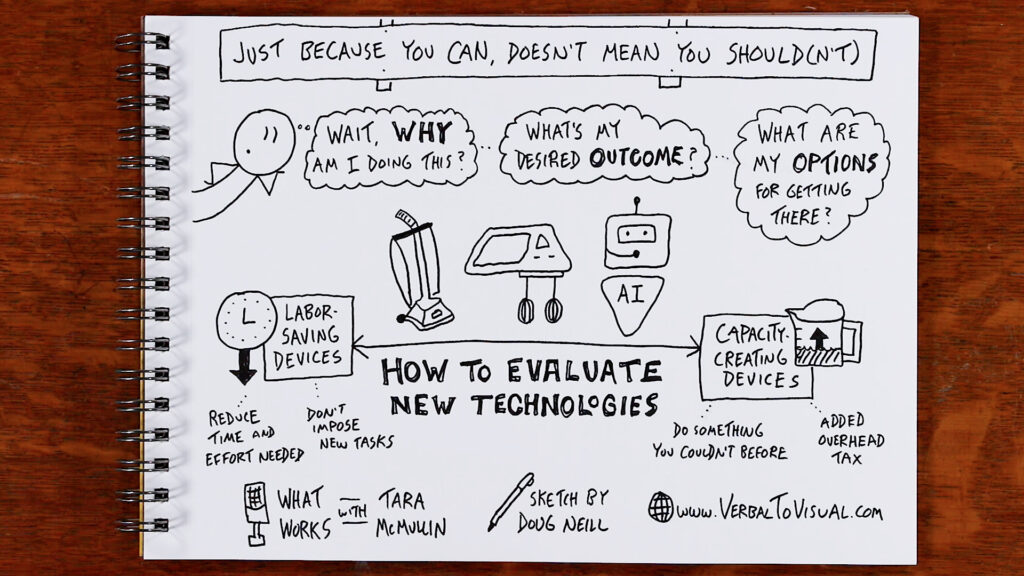
You’ve got to ask those deeper questions around why you’re doing this, your desired outcomes, and your options for getting there, while also paying attention to the degree to which any new tool actually saves labor or just creates new capacities and therefore added responsibilities.
For more, go check out the What Works podcast with Tara McMullin. These ideas come from the May 21st, 2026 episode titled “Just Because You Can: The Eggbeater Effect Revisited.”
If you’ve enjoyed the way that I’ve sketched out these ideas, this is a skill that I teach. It’s called sketchnoting, also known as visual note-taking, and it is a technology of sorts, one that helps me reach my desired outcome of engaging meaningfully with good podcasts like this one and the good books that I’m reading, and then remembering more of those ideas because of the visual summaries that I sketch out.
If you too would like to build this skill, check out our library of courses.
Cheers,
-Doug