Have you ever sketched something during a conversation or while processing an idea, and then later looked back at it thinking, “This is fine, but it feels… shallow”?
You capture the main points, you make some icons, maybe even add a nice visual structure. But something’s missing. It doesn’t quite capture what was actually happening beneath the surface.
The Framework
In that situation I think you’ll benefit from Kelvy Bird’s Four Levels of Scribing framework. It gives us a way to think about depth in our visual work. Not as a binary of “good” or “bad,” but as a progression we can intentionally move through.
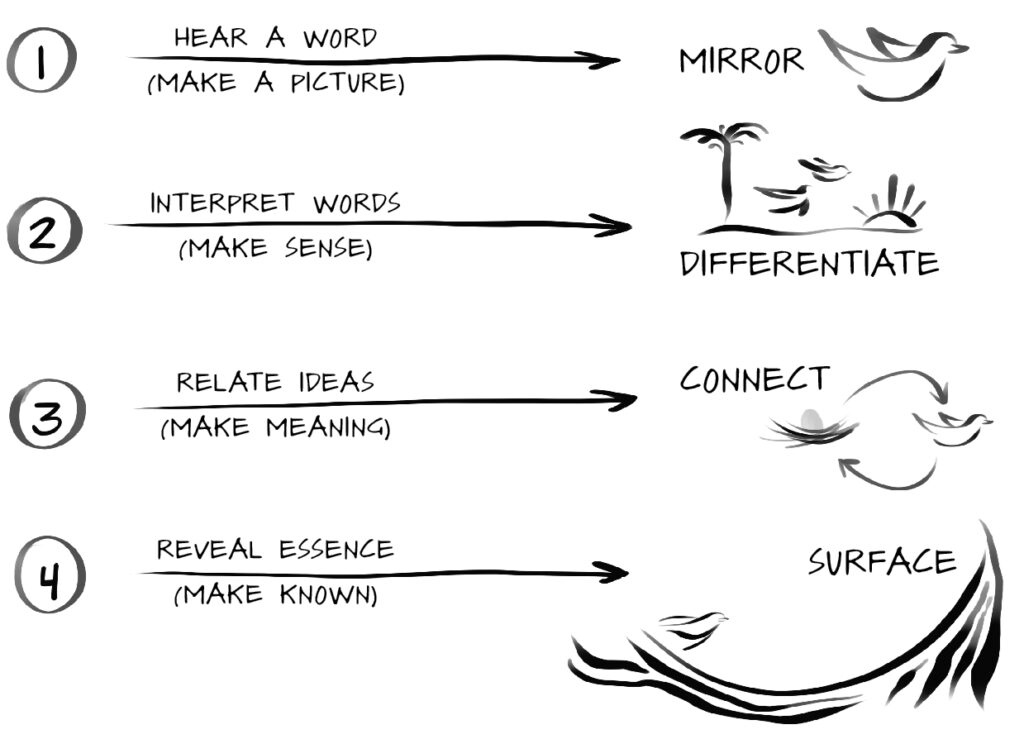
Level 1: Hear a word, make a picture.
This is mirroring. Someone mentions a bird, so you draw a bird. It’s direct, a literal translation from verbal to visual. And there’s nothing wrong with starting here. In fact, it’s often exactly where you need to start.
Level 2: Interpret words and make sense.
This is about differentiating. Instead of drawing that bird in isolation, you put it into context. What’s the setting? What else is happening in the scene? You’re adding meaning by showing relationships between elements.
Level 3: Relate ideas and make meaning.
Here you’re connecting. Maybe what’s really being discussed isn’t just a bird, but a life cycle, from egg to bird to nest and back again. You’re looking for the system, the process, the structure that ties disparate elements together.
Level 4: Reveal essence and make known.
This is where it gets interesting as you surface something that hasn’t been explicitly stated but is present in the room or in the conversation. You’re tuning into what needs to be brought forward, giving it tangible form on the page so people can interact with it.
What I appreciate about this framework is how it emphasizes the progression from practical to emotional, or even better, the integration of the two. Moving through these levels isn’t about abandoning clarity for abstraction, it’s about bringing more of yourself into the work. More attention, more feeling, more sense-making.
Experimenting with the Four Levels
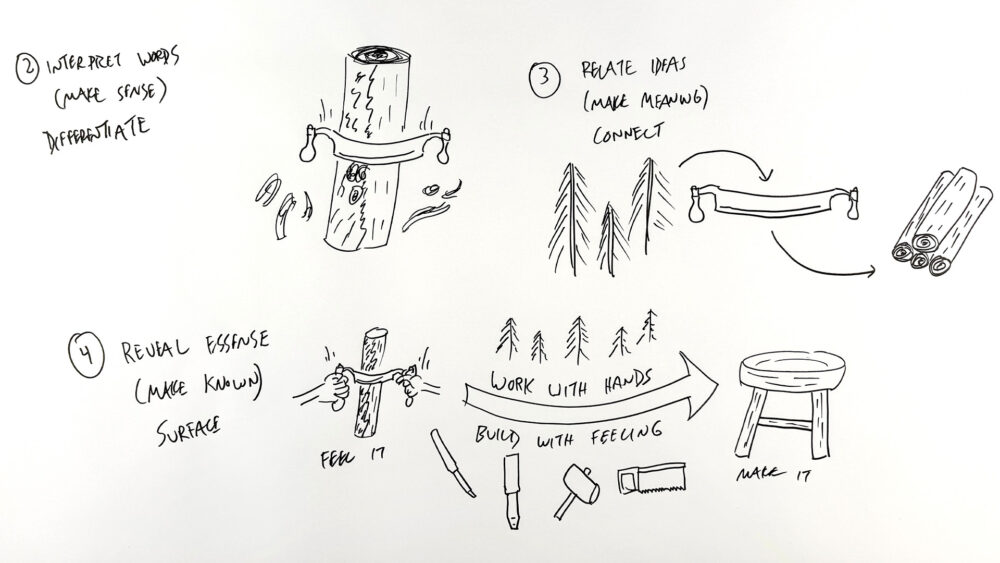
I decided to try this out myself with something I’d been working on recently. I’d picked up a bunch of woodworking hand tools from a local store that was going out of business, and I’d been using one of them, a draw knife, to strip bark off some wood from our property.
At level one, I just drew the tool itself. Pretty straightforward representation of a draw knife.
At level two, I showed it in action: the draw knife in use, stripping bark off a piece of wood. Now you can see what it does, not just what it is.
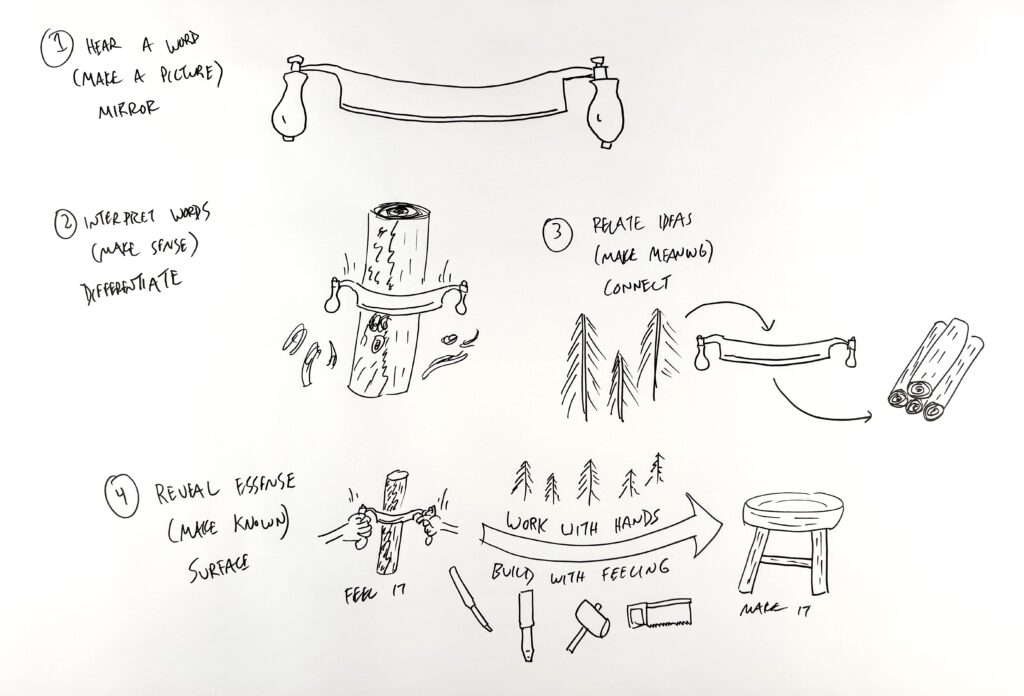
At level three, I created a process diagram: trees on one end, the draw knife in the middle, then a stack of debarked logs ready to use. The full journey from raw material to usable resource.
At level four, I tried to capture the feeling of the work and what it’s really about for me. The physicality of working with my hands. The satisfaction of building with materials from my own land. Creating things with purpose and intention. That deeper why beneath the simple act of removing bark.
Here’s the thing: not every sketch needs to reach level four. Sometimes level one or two is exactly what’s needed. But if you’re feeling like your visual thinking practice has plateaued, try this: take one concept and deliberately work it through all four levels. See what emerges. Notice which level feels most natural and which requires more effort.
What situations are you currently facing that might benefit from this deeper level of visual processing?
Where could you move from just capturing what’s being said to revealing what’s really going on?
Check out Bird’s book Generative Scribing for more on this approach to meaning-making within groups.
And if you’d like ongoing support as you develop these skills and learn how to create visual models that capture not just the surface but the essence of ideas, come join us within Verbal to Visual for on-demand video lessons and weekly live workshops.
Cheers,
-Doug